INTRODUCING

Christina Leslie's Portraits

N.L.S., A New Local Space

Deborah Caroll Anzinger's artist run residency and exhibition space in Kingston

ON THE SCENE

Leasho Johnson's Provocative Re-interpretation in 'Canopy Guild'

Light Sensitive

Marlon James' black and whites

Annalee Davis: ON THE MAP

Caribbean Political Documentary

Friday, June 6, 2014

ON THE SCENE: Diversity Spreads in the Kingston's Art Scene

Members of the JA Cosplayaz in character and costume.
Over the last couple of weeks, I have had the opportunity to attend a few of the art events happening in Kingston. From exhibitions featuring Hello Kitty to online events enabled by YouTube Live and Google Hangouts, there has been a range of experiences to be had. Our local art scene is not necessarily being compared with other more expansive and developed scenes overseas but it is being seen in its own context.

Sento-kun character inside the exhibition 'Japan: Kingdom of Characters'
LOCATION: DOWNTOWN
The local micro-culture of youth involvement and and admiration of Japanese Manga and Anime would have been sated by ‘Japan: Kingdom of Characters’ now on at The National Gallery of Jamaica. The event even featured the budding society of teenage and college-age cosplayers who perform under the name JA Cosplayaz. The pop culture of Japan has obviously hit a nerve with them as their Facebook  group has 1,746 members and has found endorsement from the Japanese Embassy in Kingston. In addition the opening featured the newly formed local alternative Reggae band, The Sky is Broken, performed several songs from Anime sources in its original language. The exhibition itself demonstrated for the beginner a general survey of the history of Anime and Manga in Japan from the 1950’s and 60’s to the contemporary period. The objects, materials and audio-visual titles on display cover large toy collector’s figures such as Mobile Suit Gundam, life-size plushy suits of regional characters such as the city of Nara’s beloved character Sento-kun, miniature anime dolls, video projections of contemporary satirical animations like those made popular by Zuiyo Studios. This exhibition runs until June 14th.


Installation view of 'Canopy Guild' at NLS 

LOCATION: MOUNTAIN VIEW
Leasho Johnson's reworking of Rodell Warner's imagery
In contrast to the scope of the show at The National Gallery, NLS currently features in their micro-gallery the results of a collaboration between local and overseas artists exploring the work of their resident artist, Rodell WarnerThe exhibition, Canopy Guild, started with an opening event on May 9th and runs until June 28th. The public may view the show by making an appointmentWarner began his residency by visiting various sites in Kingston to photograph aspects of the landscape such as tree formations and leaf clusters. The photos were then processed and reworked via Photoshop and became new imagery for digitally printing on fabric and applying by hand patterns to paper. This imagery and the source photographs also became raw material for the other artists to make garments, video, sound and paintings. One of the most interesting things about the show is how Warner’s work seems to encapsulate the space and draws you in by folding and crumpling the paper to form three-dimensional wall structures.

Booths setup on the grounds of The Chinese Benevolent Association

LOCATION: LIGUANEA
Andranique Morgan's ceramic works at The Liguanea Art Fair
Leaving from the contemporary art nucleus which the NLS show presents, the Liguanea Art Fair was open at the Chinese Benevolent Centre on June 1st for one day. The fair showcased dozens of artists and creatives who sometimes fall outside of the contemporary art scene in Kingston for various reasons such as geographic location, differing markets and tastes. There were also various artists who have connections with the Edna Manley College of the Visual & Performing Arts as Alumni or as Faculty. The scene was lively but relaxed with food, music and outdoor and indoor booths. The work on display ranged from hand-made instruments, to large colourful canvases, garments, miniature objects made from found materials and various eye-catching displays of hand-made local jewelry. 

Megan McKain's Jewelry Collection
It is a shame that this is only a one day event. It would be good if some kind of regular event could be organized for all kinds of creative pursuits to be made available to the public on a regular basis. The Liguanea Art Fair curates submissions as they seem to be distinguishing between what they want to offer and local craft market-style products. They do now have a Twitter account and Facebook page.


LOCATION: NEW KINGSTON
Documentation photo courtesy of Motza Motza (Facebook User) via Invisible Presence: Bling Memories Facebook Event page
NLS’s art radio’s last broadcast of the IN series discussed Ebony G. Patterson’s protest/ art happening staged behind the procession of the bands at the Jamaica Carnival parade. The Carnival’s Grand March happened simultaneously with the flash-style performance on April 27th. Planning and gathering of participants as well as the making of the coffin-shaped objects began months before the actual event. The performance proved successful in its shock-oriented strategy as local entertainment and newspaper style sections  gave air-time and page space to feature the happening. The effect is reminiscent of the unsettling feeling of the New Orleans funeral parade particularly of the scene from Live & Let Die. Apart from the flash aesthetic of the work with its multi-patterned coffins mounted vertically on poles transported by costumed participants, the effect conveys more serious intent. The artist talked about wanting to bring attention to the over 73 persons killed during the 2010 Tivoli Gardens Unrest in Kingston. The performance I would imagine, matched the brightness of the main parade as well as taking onlookers outside the Carnival experience.

Art events are ongoing in Kingston, particularly in the mid-Summer. We can look forward to the opening of the Edna Manley College of the Visual & Performing Arts’ Final Year Show on June 7th @ 6:30pm. Kingston Art on the Edge-fuelled exhibition ‘Social Atrocities’ is also coming up at Olympia Art Gallery on June 26th and. Did you attend any of these events or other? What did you think?

Saturday, May 17, 2014

ON THE SCENE: Theatre tackles Science in 'HeLa'

Adura Onashile performs solo in  HeLa
The HeLa cell has been a major component driving the major scientific research and advancement in the last sixty three years. The particular qualities of the cell to grow rapidly and it’s resilience has made it an invaluable component in over 90% of scientific labs worldwide. If we think about the scale of which the HeLa cell has had an impact we can think of research in the HIV vaccine, In vitro fertilization, prescription pharmaceuticals, genetics and cloning. This is however a list of facts which you could find in any search engine a few clicks away. We often think about and even more importantly hear about Science in this way.


The HeLa cell in its very name carries with it a more personal but troubling story. It is this story which British-based performer Adura Onashile gave a powerful treatment in her one woman play, HeLa. The name HeLa comes from the hospital lab’s abbreviation of the name Henrietta Lacks. Lacks was an African American woman who was diagnosed with cancer at a hospital in 1961. The other part of her story is that a cell sample was taken from her during her treatment without permission thus beginning the story of the HeLa cells in scientific research. From that moment, even though the course of modern science was set on a path of rapid and highly innovative discoveries enabled by the HeLa cell, the family of Henrietta Lacks was set on another. Onashile in her composed and convincing portrayal of Henrietta’s daughter, Henrietta, The Narrator, The Lab Technician and other characters, relayed how the family have constantly questioned and sought to protect and reclaim the ‘spirit’ of Henrietta as she lives on in some form through HeLa cells worldwide. At one point, we realise via one of the characters that Henrietta Lacks is the only human to ever have more cells outside her body than inside it.  

The dramatic imagery  & sound of 'HeLa'
Various questions of the ethics in conflict with the ambition of the field of Science come in to play. Onashile’s voicing of Henrietta’s daughter finds her thinking about the cells as pieces of her mother who was exploited by her own doctors. In other segments of the performance we see images and video projected of the various Nobel Prize winners whose research and scientific discoveries depended on the use of this immortal cell line. Many of the issues raised are not new questions, as those of us paying attention to worldwide news would be familiar with the issues of ethics involved in the manipulation of nature involved with scientific research such as Stem-cell research. What ‘HeLa’ presents is an argument for humanizing and reconsideration of how Science’s race towards advancement occurs.


The history of The HeLa cell line is delivered to the audience
The performance was pared down with elements of multimedia, dance and the set working to present a sometimes abstract and sensory and at times clinical experience. Onashile managed to step back and forth between place and time notably by her use of various regional accents and use of a small number of props such as a large chalkboard recounting the names of scientists benefitting from the Henrietta’s cell line. The performance was followed by a Q & A session which left audience members with the beginning of a dialogue about the issues. Eventually though you ask the question, is it ok that the HeLa cell was taken because of what it has contributed; or does the greater good of scientific advancement trump individual rights? 

The play was sponsored by The Jamaica Cancer Society and staged at Edna Manley College of the Visual & Performing Arts. It was directed by Graham Eatough and inspired by ‘The Immortal Life of Henrietta Lacks’ by Rebecca Skloot.

Tuesday, May 6, 2014

INTRODUCING: Christina Leslie’s Portraits


Christina Leslie, The Video Hoe Vixen

Curated art site, Wondereur’s most recently selected artist to watch is Christina Leslie. Leslie creates using photography and African and Jamaican art collector/ curator Kenneth Montague describes her work as having ‘a deep poignant message around multiculturalism’ with ‘a terrible beauty’. Leslie has connections to Jamaica but lives and works in Canada. A selection from her series of recent double portraits can now be viewed. Each work uses two versions of the same person placed next to each other. The automatic impulse is to search for the relationship between the images or to compare them. In one of the double portraits, the close-up frontal photograph of a young black woman’s face is placed beside another photograph of the same woman in  blackface and a blond wig. The work’s title, The Video Hoe Vixen is what readily reveals how each image informs the other.

Christina Leslie, Calcutta Curry Boy
Her work offers two representations of the young woman and asks us to choose, to reflect, to think and associate these with certain realities and experiences. She asks friends and family to recall their own personal experiences with racial issues and assumptions about their identity. These stories apparently influence the images she decides to makes. Other works such as Geisha The China Doll, Calcutta Curry Boy and Bollywood Beauty present similar stereotypes which minorities in North America  may have experienced. With each of the double portraits, each individual goes through a transformation via masking of their faces and bodies with makeup and costumes which reflects the racist imagery concerning their ethnicity. “I might be opening up old wounds’ she says ‘but it’s not about throwing salt into them. It’s about opening up a conversation.”

Olivia McGilchrist, Red Dress 3

This conversation about racially problematic imagery is one which finds a connection with the various dialogues, voices and viewpoints in various contemporary art practices in the Caribbean. In 2009, Leslie showed work alongside other artists, including myself at the Rockstone & Bootheel exhibition at Real Art Ways in Connecticut. The show featured the work of artists connected to the Caribbean who were exploring various complex layers of Caribbean identity and experience. In particular there is a connection with the concerns of Renee Cox, Ebony Patterson and Marlon Griffith. In that exhibition the artists were involved in re-contextuazlising and thinking about identities via photography. Charles Landvreugd and Olivia McGilchrist’s work presented in other forums relates to this visual language of reclaiming and taking on stereotypes by using masking and cloaking of the body in reference to popular culture and thought.

The juxtaposition in Leslie’s work does play on the ideas of dual truths about individuals. How we see ourselves and how we are seen is a major point emerging from the work. The work holds two striking yet opposing points in that perhaps stereotypes do hold a version of a truth after all; and revealing that all images are constructed for desired effect. Leslie says about her work that “If one less person laughs at one less racist joke, I’m still doing my part in it.” These issues cannot be expected to be directly transplantable in the Caribbean. While we do speak about imagery and representation I don’t know that racism can be understood in the Caribbean in the same way as that which the artist attempts to counter.  Her dialogue is clearly aimed at the particular atmosphere in Canada and the U.S. but it finds kinship with the kind of work other artists are doing regionally.

See the full photo-journal story on Christina Leslie’s process and work at Wondereur


Tuesday, April 8, 2014

The Importance of Social Art Spaces

Students of the Time-based Media course at Edna Manley College participate in a studio visit at NLS
Over the past three weeks I have had the opportunity to engage in different ways with the new local space, NLS. The space has been active for about a year and is run by Deborah Caroll Anzinger and a small team of volunteers. With each visit a new opportunity presented itself to the various hats I wear as contemporary artist, art educator and arts writer among other things. On my first visit I had the chance to meet the newly arrived artist participating in the residency programme, Rodell Warner.  There was also the chance to present my work to visiting curators and catch-up with other artists.

Local artist, Leasho Johnson talks about branding, sexuality and identity in his current work
On the next visit there, just a week after, myself and other artists had the chance to have discussions about trends in art, the local art scene and look at each others work. The interesting part for me was that even though as local artists we were familiar with each others work, this more intimate, personal and social setting was a rarity. There was the realization that as artists we mostly ever saw each other's work when it was already smoothly projecting the aura of 'Art' after being mounted in national and international exhibitions. We never had public chances to see the developmental stages and phases or to listen to the background and ideas of the work. What occurred to me was that we mostly understood each others work as exhibition items or tools to win curatorial, institutional and public favour and notice. This second visit to NLS made me ask the question as to why local artists didn't meet to discuss and show their work to each other more often. If like our Tourism industry we only ever maintain links with the external purveyor of our 'goods' then an element of non-sustainability and risk of exploitation may creep in. 


Visiting artist, Rodell Warner, explains development and technical processes in his work to students
 That visit pushed me to make an appointment to have my current class of Time-based Media students from Edna Manley College make a studio visit with Warner. This past week the students took an approximately twenty minute walk over from Edna Manley College to NLS at Mountain View Avenue to listen to Warner's presentation. The proprietor, Anzinger began by introducing students to the micro-gallery/ studio and outdoor yard which form NLS. We heard about the yearly curatorial programme and open-call submissions from artists as well as the local and global initiatives being encouraged. The presentation once again fueled questions as to how the art scene and creative industry locally and regionally would be affected if more little hubs of small but active local spaces like NLS were to start-up. It is encouraging as Gallery 178 downtown has also recently had its first committee meeting so good things should be in store. There are undoubtedly many more local spaces and groups but the interconnectedness with each other and public awareness is thin and thus makes these spaces sometimes difficult to access. It can only create a healthier cultural environment if multiple independent spaces, encouraging social interaction and supporting creative practice were operating. The result might lead to the much needed diversity and counter-balance to often all-encompassing and sometimes exclusive state-initiatives for creative industries and The Arts.

Have you interacted with NLS or are involved with another independent initiative which facilitates local creative practices?


Wednesday, February 5, 2014

Stefan Clarke :Artist Talk's at Edna Manley College

Stefan Clarke explains his work during an artist talk at Edna Manley College

Edna Manley College's School of Visual Arts (SVA) has a semester long programme of talks designed to stimulate both members of the art community and students alike. On select Thursday afternoons from 2pm to 3pm, a selection of SVA's faculty will be presenting their work and engaging in dialogue with the audience. Last Thursday's talk showcased Stefan Clarke's work which uses a combination of labour intensive processes involving Sculpture and Photography.

He spoke passionately about the sweet spot of his work lying in planning, staging and construction of his spaces, body armor and image-making.  He also described his constant involvement in both public commercial work and commissions and its importance to funding his more personal conceptual projects. His involvement in the design and installation of spaces for major local party and session events are equally as important to his practice as his metal work fashion pieces and digital photography.

Clarke, a particularly society-challenging artist, facilitated discussions which encouraged students to take more interdisciplinary approaches, self-teach dying techniques and to constantly stay curious and excited about creative practice. One of the issues he bemoaned was the constraints of finding models open to participate in the creation of his photographic images in a conventional society like Jamaica.

Upcoming talks will feature The Sculpture Department's Jeff Menzies. To find out more about this series you may get in touch with co-ordinator Katrina Coombs.

Thursday, December 19, 2013

The JCDC Visual Arts Exhibition: A Niche in Creative Development

Dwight Larmond
The Jamaica Cultural Development's (JCDC) annual Visual Arts Exhibition is now open for public viewing at The Jamaica Conference Centre, Downtown. It runs until December 22 and opens from 10am to 6pm from Mondays to Saturdays. While there, I had the chance to catch up with Sana Rose, JCDC's Visual Arts Specialist at the exhibition last week. We spoke about many things related to The Arts in Jamaica and how the Visual Arts Exhibition fits within that scope. With the unfortunate closing of The Mutual Gallery earlier this year in an art system as small as ours is in Jamaica, each organization serves a specific and vital role.

Stephan Shedrowitz
 I asked her how she felt the exhibition fit within the scope of the current art scene. She explained that in her years spent working on the annual exhibition,  she has come to understand that there are different pathways for visual artists in Jamaica and the JCDC presents one such option. The JCDC's Visual Arts Exhibition doesn't seek to achieve what The Mutual Gallery did with its contemporary edge geared towards collectors; or what The National Gallery does with its expansive shows designed to reflect the current climate and document and highlight past moments. The JCDC provides access and encouragement for both trained and untrained artists in the early stages of a career or who operate outside Jamaica's more established and sometimes more elite art system. We spoke about a realization that The JCDC'S Visual Arts Exhibition reflected also a different Art model within the cultural landscape and that the artists in the show benefit by embracing it as a show which frames creative output in another way.

Antwain Clarke
As a former JCDC Merit awardee myself, while first studying at art college, I can agree that The JCDC's role at the time for me was to provide an outlet to showcase ideas I was not sure had worth and to build the esteem of a young artist trying to work things out what Art was. The show this year was presented in a way that did not highlight the clear differences between so called amateur art and career artists. This was interesting as you could see the legacy that artists of older generations had on these artists who ranged from age 6 to adulthood.

Jermaine Morgan
Antwain Clarke's narrative conceptual drawing, 'Fermentation'  shows connections to artists who have shown regularly at The National Gallery such as Roberta Stoddart, Khary Darby and Phillip Thomas. The drawings framing of its small figures shown frozen in the midst of activities in an imagined world, while the environment holds the keys to the mystical story. Stephan Shedrowitz's assemblaged sculpture, 'Mama Maria: Protector of Lost Souls' reminds me of a tiny African deity scaled up to human size. The sculpture also reveals various entry points for viewers to begin thinking about its story. On the other side of the Sculpture/ Assemblage category is Jermaine Morgan's on trend platform heel shoes but the twist is that it is made completely of mackerel tins. Dwight Larmond's Ruins of War, evoke American artist, Leon Golub's work while documenting the politically-charged current events in Jamaica. The painting's use of a stlye similar to the look of documentary photojournalism hints at the role of the media in such problematic events.
Morgan's 'Tin Boom: Hot & Spicy' does make us think harder about how much raw material the creation of art uses and how artists can better think about better environmental efficiency. Michelle Lee Lambert's paper work shows another side to the creativity that is currently happening in Jamaica. Her work 'On the Pond', uses layers of washes of thin paint on textured paper surface to create a soft impression of the natural occurrence of light reflecting on water's surface. Lambert's work finds familiarity with noted artists Monet, Rothko and also local artist Tricia Gordon's work. It is also good to see that there is still interest in Painting.

Michelle Lee-Lambert
There is so much to look at with this exhibition that it is so difficult to discuss it all here. What showed however was that the Art that those in the youth category had the facility to make these days has become much more expansive. It is also interesting to see how photography has taken off as a way for people to express and document this culture. The show in general has an overtone of humour towards life, awareness and curiosity about creative activity in various forms and pride in documenting local life and environments. There is also outside the exhibition space, an ongoing painting which the public can participate in to add to the general air of the encouragement of creativity.

Have you seen the exhibition? What did you think? What other kinds of organizations does the creative industry in Jamaica need? 

Friday, August 16, 2013

Graphic Novels & Cartoons in the Caribbean

Lauren Hinds at her desk working on her comics
In contrast to my time studying at Kyoto Seika University in Japan, one of the main hubs of Manga and Comic research, the Caribbean has not been as acutely aware of sequential art/cartoon/ comics as a creative practice. Many of us in Jamaica for example, grew up exchanging Archie comics, borrowing a few Marvel and DC comics from friends and reading the Sunday funnies. The stories in these comics have often not been our own however. The appeal has always been there for these very relate-able and human stories which poke fun at daily life situations. The Jamaica Observer and The Daily Gleaner both feature the work of acclaimed cartoonists Las May and Clovis. These at least are daily reminders and reports which poke fun and satirize the political and social situations. Many cannot close the newspaper without their daily fix, whether it be local or syndicated from overseas.

There has also been a huge influence of Japanese animation on Caribbean creatives however and occasionally there will appear reports of Caribbean comics which closely resemble either the DC/ Marvel aesthetic or Anime and Manga (Japanese comics). It can leave us as audiences thinking that comics are an artform dominated by pre-programmed aesthetics from other regions and also as a more male-oriented artform. I recently spoke with Lauren Hinds whose work takes a different approach. She is influenced by literature and her work deals with issues such as growing up, being an outsider, relationships and friendships and internal dialogue.  Her work relies mainly on the visuals rather than the wit of her words even though the words themselves are often quite poetic. Lauren talks more about her work with me below.

You run a blog, "Sketch in Stories", what motivated you to start blogging publicly about your creative journey and how does blogging contribute to your creative work?


I started my blog by guess not really putting much thought into what I was going to blog about. It then turned into an avenue for me to become confident and comfortable about letting my work be seen. I think visibility is important if you want to take your work seriously and be successful at what you do. If anything it has contributed to pushing me to be my best and zero in on the   projects that I enjoy doing.

 
You trained at the Center for Cartoon Studies in Vermont, what was that experience like and what do you feel you took from this experience?

Being a cartoonist is a very humble profession. I think anybody who decides to become a cartoonist must know that it will push your skills at different levels. You have no control over what that will do to you. I went there not knowing much about comics except for reading Archie Comics, Mad Magazine, Photographic Romance comic books, the odd comic strip in the newspaper then later Graphic Novels. Because I went in sort of ‘naive’ about comics at CCS, I soaked up everything and questioned everything even things about myself. It worked for me and  I believe at the end of that experience I became who I wanted to be, a cartoonist.


On returning to Trinidad, how did your training at The John Donaldson Technical Institute and time as an Illustrator and Graphic Designer increase or change your creative options and outlook?

Those skills I acquired in the early part of my career have been good foundations going into comics. I definitely feel both occupations have brought me to this point in my life. They’ve added tremendous benefit to the process of making comics which demand the ability to illustrate and design a sequential story well. I also feel I can make better creative decisions due to these skills.

Frames from Lauren Hind's Outaplace

Your online comic "Outaplace" first caught the notice of ART:Jamaica as having a different perspective from a lot of the visible Caribbean comics. It is about a little girl at school, told from a female perspective and it doesn't explicitly reference Marvel, DC or Japanese comics. Tell us what “Outaplace” is about and what the story will develop into and what influenced it.

Comics has provided me an outlet to tell stories and give my perspective on topics that interest me. I feel that I’m bringing something unique to an audience who still view comics as only humorous or it has to have the appeal of mainstream comics to be accepted. My hope is to continue making honest stories I enjoy, using my voice.

Outaplace actually began with the present character in my comic strip, Frances Rustlebean. I wanted to introduce a girl who was very assertive, who said and did many quirky things. As I wrote and drew more she developed into a meek character who didn’t fit in at school and couldn’t make friends while questioning her place in the world. I approached the story from both a personal and observational account of how girls socialize with each other where they all meet for the first time, at school. Based on those experiences both good and bad it determines who they become. The main character is older, at 11, on the cusp of becoming a teenager who moves to a new school in the city. It’s a view into her world as she makes those transitions. Outaplace is being developed into a book, roughly about 64 pages.


A page from Hinds' graphic novel- in - progress, Wingless

You have a new project called "Wingless" which is a graphic novel. Is this based on Jamica Kincaid's short story of the same name? Will this be published as a book and what is it about? The initial drawings you have shown are very eye-catching, how do you develop the aesthetic and story of this seemingly personal graphic novel?

Constructing a story where I am the main character has forced me to peel away many layers of myself, as I grow, the story grows as well. It’s hard to explain how I developed the aesthetic for those initial pages, they were really based on a feeling or a memory while I was abroad. In some cases the writing came first, other times the image but I always leave some room for fantasy and the unexplained, it keeps the story interesting.

 Although I had been gradually developing this story for some time as it was initially called "Fear". The title changed when I came across Jamaica Kincaid’s short story Wingless. It was fascinating to me that there was so much subtle connections in her poetic prose, imagery...I saw myself, my story.The narrative started to come together as some of the themes I was exploring in my writing and illustrations had been written in her short story. There are underlying similarities - the constant use of nature as a mode to self-discovery that keeps recurring in my work also. That aspect of Kincaid’s story I’ll be exploring further in my graphic novel. Wingless is still being developed, not sure yet how much more of her work will be reinterpreted in mine. My hope is to have my book published.

 See more of Lauren Hinds' work and contact her at her blog Sketch in Stories 

Wednesday, August 14, 2013

Residency and Exhibition Connects Regional Artists


Ateliers '89 Foundation and the Mondriaan Foundation in collaboration with ARC Inc., and The Fresh Milk Art Platform Inc. presents Caribbean Linked II, a residency programme and exhibition which will take place from August 25th through September 6th, 2013 in Oranjestad, Aruba. Invited Artists include: Omar Kuwas (Curaçao), Veronica Dorsett (The Bahamas), Mark King (Barbados), Shirley Rufin (Martinique), Sofia Maldonado (Puerto Rico/US), Dhiradj Ramsamoedj (Suriname), Rodell Warner (Trinidad and Tobago), Robin de Vogel, Kevin Schuit and Germille Geerman (Aruba). The selected artists were chosen collaboratively by Annalee Davis, Holly Bynoe and Elvis Lopez.

Caribbean Linked II will be held in association with Studio O, Terafuse, Museo Arqueologico Arubano, UNOCA, San Nicolas TV, Departamento di Cultura, SVE TV, Alydia Wever Theatre Dance Company and Gang di Arte Aruba. Most popular through Facebook and social media platforms, to be linked or to be connected is the world’s most common way to be associated right now. This residency and exhibition will present young talent while raising issues of their collective futures by discussing the survival of artists, and the sustainability of local creative communities that nurture their development and maintain their connectivity. This residency becomes a crucial space for building awareness across disparate creative communities in the Caribbean and its diaspora by finding ways to connect young and emerging artists with each other. Selected participants will engage in two weeks of open discussion and critiques, various professional workshops, visit established local artists’ studios and better understand the creative cultural industries that propel Aruban art. An exhibition of work produced during the residency will be displayed at Ateliers ’89 and will open on September th5

.

Collaborating local artists include Alydia Wever, Ciro Abath, Evelino Fingal, Glenda Heyliger, John Freddy Montoya, Marian Abath, Nelson Gonzales, Osaira Muyale and Ryan Oduber. Collaborating partner professionals and institutions include Vivi Ruiz of the Archaeology Museum of Aruba, Lupita Giel of UNOCA and Siegfried Dumfries of the Department of Culture.

Participating institutions include:

ARC Magazine -
ARC Magazine is a non-profit print and online publication and social platform founded in 2011. It seeks to fill a certain void by offering a critical space for contemporary artists to present their work while fostering and developing critical dialogues and opportunities for crucial points of exchange. ARC is an online and social space of interaction with a developed methodology of sharing information about contemporary practices, exhibitions, partnerships, and opportunities occurring in the Caribbean region and throughout its diasporas. ARC’s mission is to build awareness by fostering exchanges and opportunities that expand creative culture, within the visual arts industry across the wider Caribbean and its diasporas.

Fresh Milk -
The Fresh Milk Art Platform Inc. is a Caribbean non-profit, artist-led, inter-disciplinary organization that supports creatives and promotes wise social, economic, and environmental stewardship through creative engagement with society and by cultivating excellence in the arts. The idea for Fresh Milk developed over years of conversations with other practicing artists around the need for artistic engagement amongst contemporary practitioners living and working in Barbados, with an expressed need to strengthen links with the region and the diaspora. Fresh Milk bridges the divides between creative disciplines, generations of creatives, and works across all linguistic territories in the region – functioning as a cultural lab, constantly redefining itself. The platform transforms into a gathering space for contemporary creatives who are thirsty to debate ideas and share works through local and international residencies, lectures, screenings, workshops, exhibitions, projects etc.

Ateliers ‘89 -
The Foundation ‘Ateliers ’89’ offers Arubans and others interested from the Caribbean region an orientation on contemporary applied art and design. Workshops in different disciplines as painting, installations, videoart, photography, drawing, fashion, theatrical-design, ceramics, animation, graphic design and history of art are organized in a spacious, open and comfortable setting. Established foreign and local artist teach at the studio’s. Every workshop culminates in an exhibition which is open to the public. Furthermore, there are special workshops and tours of the exhibitions for children and young students. Ateliers ’89 works in close cooperation with a number of art academies in the Netherlands. This way, young talents who started off in the workshops of Ateliers ’89 can easily find their way to a Dutch academy.


Friday, August 9, 2013

Mutual Gallery closes one chapter and opens another?

Inside the Mutual Gallery during its closing period
For ten years The Mutual Gallery built its reputation as the most prestigious of Contemporary Art Galleries in Kingston. It was much like Jamaica's own White Cube or Gagosian Gallery. Many graduates from the Fine Art programme at The Edna Manley College of the Visual & Performing Arts, continually tested out their creative ideas via exhibition there. Artists who we made contact with continually repeated the same sentiment about The Mutual being the first place they debuted as a career artist. I can’t say this as I first exhibited at Gallery Pegasus with a group of colleagues from the Painting Department while still in my third year at the art college. It was controversial for students to be exhibiting in public at this time but we had it in mind that this was practice for the day when we could actually exhibit at The Mutual Gallery. This wasn’t by accident as The Mutual’s curator/ director, Gilou Bauer, over the period organized several shows which enabled the public and art students to see what the contemporary art scene was like.


Some of the works displayed for a closing auction
Over the years The Mutual organized various exhibition series, art competitions, talks and opening events that provided a haven for young and practicing artists searching for a receptive space for their work. The closure of The Mutual undoubtedly came as a shock for local artists all over. Rumours of it spread on Facebook and via email with July being the last month its doors were open tot he public. Though the closure was said to be due to changes in the arrangements between The Gallery and The Mutual Group administration, it is deeply unfortunate that some agreements could not have been reached to keep this institution going.

A corner of The Gallery exhibiting the work of The Intuitives
With this closure, the question has been asked of Bauer perhaps more times than can be counted: ‘What is next?’ The speed at which the closing and final arrangements had to be made have undoubtedly left little time to consider the future of The Mutual. It presents a unique opportunity for reinvention as well as new initiatives and offshoots. Maybe The Mutual’s model was not as adaptable to this new harsh economic climate in Jamaica which leaves collectors more hesitant than ever about purchasing art and companies less willing to be philanthropic. There are however other ways that the art market and system can evolve to suit these changes. What seems sure is that new initiatives may need to be techno-savvy, world-culture connected, and employ inventive and alternative initiatives. With new arts spaces like NLS and Roktowa in Kingston, commercial galleries in Kingston could be taking new directions. What directions do you think the art gallery in Jamaica should take to be more sustainable?

Monday, July 22, 2013

Less is More Design in Japan

Last Summer, while walking in a little off-road in Kyoto's city centre, I saw this window display.


Arrangement of clothes hanging in the window display

Arrangement of objects at the bottom of the window display


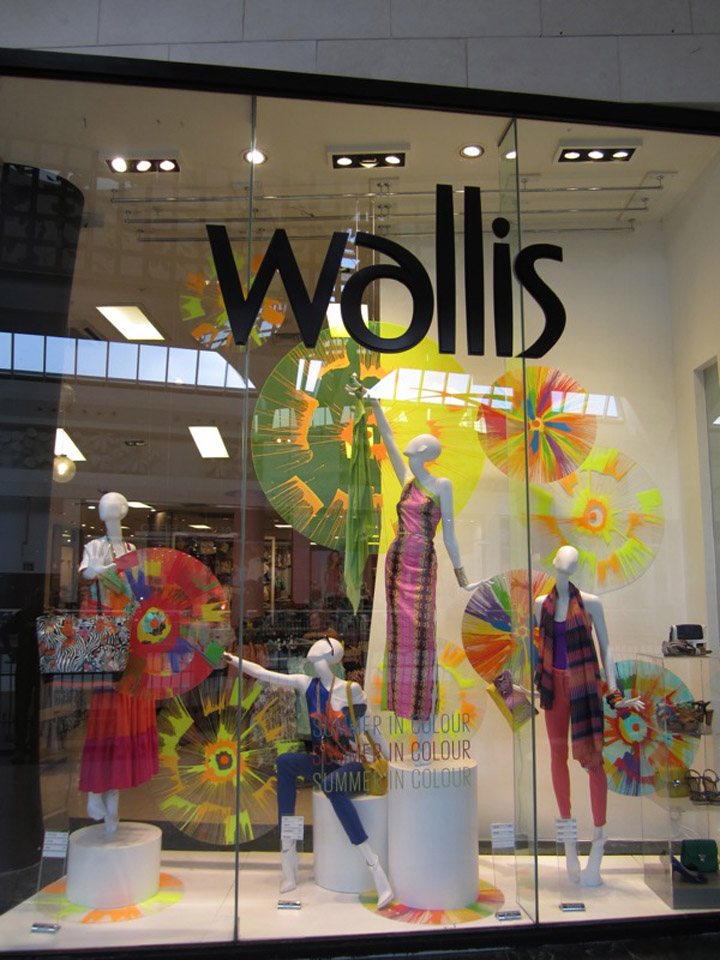
 I couldn't really believe it was a shop until checking that it did have a sign on the door and a few racks of clothes. In that street, which is next to a temple and a very quiet upscale part of the commercial district of quaint Kyoto, the store was just believable enough. It demonstrated several differences in approach to commercial design and aesthetic taste of the Caribbean. Our stores in the Caribbean are more direct and definitely colourful. They invite you to think about lifestyle and entertainment for example. Upscale UK and North American stores tend to have a very grand, opulent use of display space to trigger desire in customers. The display for UK store, Wallis for eg. shows the mannequins clothed in the wares of the franchise and other props to convey summery activities.
                                                               
Window displays similar to those seen in the Caribbean
Display Design of Diesel's flagship store


 In comparison, the display for "Urim" pictured below projects the zen-like, less is more, simple aesthetic Kyoto is famous for. It is not clear whether this store actually sells to the public or has private clientele or only serves as a space for aesthetic play. It is interesting to look at how arrangement and colour of natural elements and the goods in the store can be used as a another approach to design rather than large colorful, synthetic graphics. These are two approaches to bringing attention to the story of the brand.


Sign at the entrance of small store on Teramachi-dori, Kyoto
This is not to say that Kyoto doesn't have its fare share of large department stores like Louis Vuitton and Lacoste showing very eye-catching work. Vuitton has long been known for its collaboration with popular local artists such as Yayoi Kusama and Takeshi Murakami but this style of pared down hand-made visuals is more typical of smaller stores off the main roads.

 
What do you think is communicated by each approach? Do you think this minimal aesthetic has a place in Caribbean design?


Thursday, July 11, 2013

Sex, Drugs & Social Media


The author of Sex, Drugs & Jerk Chicken, Marcus Bird

A few months ago Marcus Bird described his experiences in Tokyo and the impact on his creativity. Now back in Jamaica, he has launched his new novel, Sex, Drugs & Jerk Chicken on Amazon. His journey is one of the creative today seeking to link the multiplicity of media and marketing tools available to reach audiences for his work. It is a story that is not foreign to many artists today who are trying to handle their own publicity and ensure that their work reaches the marketplace. He shares the source for this story and how he took the project from concept to actualization. Keep reading for tips and tricks for becoming a media savvy creator and ways of channeling your inspiration into creative content. 

The title for your novel Sex, Drugs & Jerk Chicken references the infamous song about the punk rock scene and decadent lifestyles of a particular sub-culture in the US at a certain time. Is this link to Sex, Drugs & Rock 'n' Roll of particular weight in your novel? What about the ‘Jerk Chicken’ in your title?

Just before the internet hit the real broadband stage in Kingston, my only easy access to international music was from shows like The Rick Dees Weekly Top 40 and The World Chart Show. I still remember hearing Alanis Morisette’s Ironic for the first time. I really vibed with that sort of introspective, angry music, and I think like most Jamaicans who were a little alternative, that was the inception of some of my future curiosities about other cultures.
Sex, Drugs & Rock and Roll to me is about raging through issues and life in a blur of bad decisions where you live to happily tell the tale. For most people Sex, drugs and ‘anything’ is a part of their life. People drink, people smoke, people have sex, it’s a reality. We all aren’t rock stars, but we all have decadent moments, we all make bad decisions and we all get burned. It happens sooner or later, and how people deal with it varies. This is how my book title really comes into play. Sex, Drugs and Jerk Chicken follows that line of exploration with the characters, just like us, where we occasionally dive into the shallow end of the pool and smack our heads on the bottom.
Jerk Chicken represents the Jamaican element of the book. The three main characters are Jamaican, they are literally the meat of the story, the “jerk chicken” so to speak. What else screams Jamaica like “Jerk Chicken”? I can’t think of much else.

Washington D.C. at night
You went to Howard university in Washington D.C...Does this story about three Jamaican guys in Washington D.C., come from a place within your own life experience?  
I think everyone has periods in their lives when things are revealed to them in slow bursts or all at once. A person close to you might die, a girl you love might cheat on you, you probably realize your career is going nowhere… all of these things can shatter the previous paradigms of life you held on to. There was a period of time when Washington D.C became very different for me. Initially I was insulated in the “student bubble” of Caribbean Student’s Association parties and hanging out mostly on campus. But during that time I had some issues with school and ended up taking about two years off. When I returned, most people I knew had already graduated, and I was this slightly older fellow in a sea of freshmen. So the city became my new friend; restaurants, bars, you name it. In the middle of all this noise, I started to see different sides of myself and the city around me.

Interactions with different kinds of people in different circumstances became more vivid and illuminating. Washington D.C has all these different areas, Northwest, Northeast, Southwest, Southeast, etcetera, but you also have your people who live in Virginia or Maryland and commute to the city, people passing through, school kids, lawyers and so on.  Then there are all these areas like The Mall, Chinatown, Adams Morgan and so on. In the book I create characters and scenarios that attempt to illustrate aspects of this D.C reality. I chose three characters because the strongest elements of this book; loss, isolation and searching felt like too much for just one character. I wrote about three Jamaicans because I’m Jamaican. It wasn’t an overt decision. My reality and experience as a Jamaican in most situations mirror the regular realities of other people and I wasn’t worried about anything involving authenticity.

In D.C I met tons of different kinds of people, including Jamaicans, and we all aren’t the same. Three Jamaicans in D.C is as plausible for me as three Irish guys, or three Ethiopians. What mattered mostly was their realities, and whatever situations they were in. As a writer it is also good to operate in a context that you are ridiculously familiar with, you so you get into certain nuanced perspectives on a character’s conflicts or issues based on say, something cultural, that you can really illustrate from personal experience.

Sketches for the book cover
At Howard, you studied filmmaking, How did you make the switch from filmmaking to designer to writer? How are you seeing these various roles as fulfilling your creative vision and how do they overlap and emerge separately?

I never actually switched. I say that because I was a writer first, before I got the filmmaker title. It’s funny how cyclical life is when you are a multi-talented individual, because depending on where you are, you might be using one skill for an extended period of time, but you still have a lot of other ideas burning inside you. I became a “filmmaker” technically after completing my Film Production degree at Howard University. Soon afterwards, I went to Japan and a few other countries and shot videos and spent some time fleshing that side of myself out. Now I was still writing on my blogs and for online publications, but definitely at the time, videography was more of a focus. What most people don't’ know, is that I wrote my first novel a while back, maybe eight years ago. Then, I was really gung-ho about being a writer, and despite doing a Computer Science major (which obviously I stopped) I ended up penning about four manuscripts over a two-year period. I wrote a science fiction work, a work about unrequited love, a novel set in Jamaica, and a non-fiction project. I wrote thousands of pages and pushed the limits of my desire to write.

I did all this operating within the framework of a system I used to see if I really want to do something.  Basically the system’s mantra is: if you can go to the near maximum extreme of a goal you are setting, you will really see if is something you want to do. If writing thousands of pages doesn’t tell you if you want to write or not, I don’t know what will. So, at that time, for a few of my projects, I sent out numerous query letters to agencies and publishers. After relatively mum responses from a few Literary agencies and collecting a ton of rejection letters, I said “maybe writing isn’t my thing right now.” The designer side of me emerged in between being a writer and a filmmaker. I’m a serious “ideas” man, and I always look at ideas as a balance between skill and execution. I thought a “designer” was a person with a design degree. But what I learned eventually is that a designer is a person with the skills to do design. I’ve always had ideas for web comics, t-shirts and characters, and I learned the skills to create my thoughts using Adobe Photoshop and Adobe Illustrator. So I also had a period when people called me a designer and were curious about projects that ran along those lines, so that’s why I said emphatically I never switched, I just developed a few core, very strong skill sets over a five to six year period in a few different areas.

All of this overlaps now in interesting ways. For the last few years I’ve worked hard at building a personal brand through experimentation. I made a few web series on Youtube, I wrote a bazillion essays on a few of my personal blogs, wrote for some websites, got published in a few literary journals,  designed clothing and even did some TV production. I did it all. In the midst of all these skills is simply function. Meaning, I’m able to think about something and execute it quickly relative to the project I’m working on. Because I can write, design and brainstorm it gives me a pretty insane workflow which I don’t think is easy to duplicate, but that’s how everything added up over time. What my skills allow me to do now is really look at an idea from different angles and accurately judge the variety of ways I can initially express it. When I was finishing Sex, Drugs and Jerk Chicken, because  I’m able to design the cover, I obsessed over that almost as much as the endings for the characters in the book! In fact there were many days I couldn’t even write, because I was working on different cover concepts and trying to match the feel of the novel with the feel of a cover image. Sometimes it feels like it's blazing in 3D sometimes, across multiple concepts, but I think the balance of skills I have allow me to give a different personal expression to my work, in the way a person with a small creative team would.
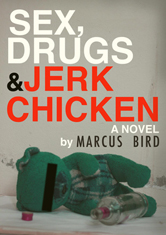
The cover of Marcus Bird's novel
Your book was promoted, launched and sold via Amazon and social media. From the initial conception of the idea through design & layout to the launch, what was your process for bringing Sex, Drugs & Jerk Chicken into the market?
The process of doing this mirrors a few campaigns I’ve worked on in the past. Since 2009 I’ve worked on a lot of trial and error methods to try and get exposure for my previous projects. What I learned was a few crucial things. One was that if you don’t tell people you are doing something they won’t know. You have to scream it, and shout it from the rooftops within reason. I love this quote I heard from American Fiction writer, Sarah Vowell recently. She said, “It’s a pretty megalomaniacal job being a writer, because you just assume that other people need to know what you say.”
This is so true. You have this concept, and this world you’ve created, and now you need inhabitants to live in it with you, people that will spend six to eight hours of their life in your mind, experiencing your journey with you. Initially it is easy to believe that people will want to go into this world with you, but that isn't the case.

What happens is that the next step is to  ask, “How can I catch people?” or “How can I introduce them to this reality I’ve created?” So you need some basic eye candy with your book cover and title  to make people curious. Then you have to figure out a way to generate significant interest for your project.  I find interest tends to generate when you state expressly what you want to do to people. I’ve found that simply posting content online in this fast-paced world isn’t enough, you need to contact people before hand, let them know what you are doing, and see how they can help. Friends with good “people equity” (an established brand for example) are good if your goals align with theirs. Once they know what you are trying to do and why and then ensure they are there to help you. It’s not that people aren’t willing, but it’s a different story if you tell someone a successful book is your last reason to live versus “I wrote a book”. That’s an extreme scenario, but you need to nail the message on the head. A lot of people pushed my book for me in ways I didn’t expect. I didn’t even ask them to, it made me realize that if I had asked more people, I’d probably even have way more exposure right now across different avenues. Also, this book had a few things going for it. One was a really catchy title, two was a cool-looking cover and three was the surprise factor. I know a few people know I make films or do design. I think many people had no idea I wrote as well, so the interest would be even higher. ‘Writing a book’ in our present reality is a big deal, so some people get motivated to help you out. On launch day I probably had more Facebook activity than the last three years combined.

I also think an  important thing is to have a lot of redundancy in what you promote, the same message everywhere. This helps keep people from asking too many different questions(which can sap time and energy). I started marketing the book subliminally for about a month. I had my Facebook cover photo as a picture of the bear with the empty bottle of liquor, taken from my novel book cover image.
The novel cover itself could be an entire interview. I went through several radically different designs trying to capture the vibe of what I wanted the book to say.  Since a big part of my design style was “cute things “ I figured I could blend cute and decadent. A teddy bear, passed out with a hidden identity seemed perfect and fit with the title and also what I wanted to say about the book. Innocence lost, bad memories from the past, there are a million things a person can associate with the image, which makes it better.

The launch was just contacting a lot of people, making a video explaining what I was trying to achieve and giving them a date, plus a reason to buy on that day. I blasted this promo on Facebook, Twitter and Youtube and worked on getting a list of people ready to buy on launch day. Then I formatted the book in Microsoft word and published it through Amazon using the Kindle Direct Publishing program. I chose this because these days everyone has a device they can read on, and it would be easier for people to get the book this way even if they didn’t have a Kindle.

What's next in your plans for this book? What targets do you have for developing this creative project? Will we see a film, audiobook or webisode for eg.?

I want to be the Jamaican Hugh Howey. Like most people with a project like this, I actually want it to do well. What’s weird is that right now I’m not thinking like an artist, I’m thinking more logically about PR and trying to do better SEO (search engine optimization) for the web and seeing how well I can work with the Amazon marketplace. I see the book starting on the Kindle, and eventually going to print in the near future.

It is hard to really gauge what you think will happen from something you made up in your head. I think most writers who get successful are pretty shocked themselves, simply because of the way the odds work. I can’t say I’ve told myself I will sell millions of copies of this book. What I’ve definitely told myself is that the book is super marketable because of the title and the very attractive cover. I believe that alone will start to attract some readers. Then, I’m reasonably confident in my writing ability, so I know the writing isn’t terrible, or waning, and doesn’t drift here and there. The characters have issues, are interesting and conflicted. So I know these three key things are solid for credibility.
The only other real consideration is numbers. How do I get thousands of people reading so I can start seeing tens of thousands of downloads? I’m testing out a few things with Amazon to do just that. I believe with some good promotion and if Amazon pushes my book even once, it will become one of “those” books that do well.

I have a few plans in place for some tangential marketing around the book, but I need more time to think about it. A web series related to this book needs to make logical sense. So does a podcast. Do we talk about Sex, Drugs, or Jerk chicken? It has to have a relative synergy.
To date I’ve done a lot of investigative video journalism in a simple way. I go to interesting places and occasionally talk to interesting people. Maybe I’ll do something where I’m chasing hot girls or something, but it has to be logical and fun. I definitely think a film can happen with the right team and budget, the world needs another D.C arthouse film!

What projects have you used social media to launch? How did it work out?
See more about this book project here
Purchase the novel on Amazon here