 |
| The author of Sex, Drugs & Jerk Chicken, Marcus Bird |
A few months ago Marcus Bird described his experiences in Tokyo and the impact on his creativity. Now back in Jamaica, he has launched his new novel, Sex, Drugs & Jerk Chicken on Amazon. His journey is one of the creative today seeking to link the multiplicity of media and marketing tools available to reach audiences for his work. It is a story that is not foreign to many artists today who are trying to handle their own publicity and ensure that their work reaches the marketplace. He shares the source for this story and how he took the project from concept to actualization. Keep reading for tips and tricks for becoming a media savvy creator and ways of channeling your inspiration into creative content.
The title for your novel Sex, Drugs & Jerk Chicken references the infamous song about the punk rock scene and decadent lifestyles of a particular sub-culture in the US at a certain time. Is this link to Sex, Drugs & Rock 'n' Roll of particular weight in your novel? What about the ‘Jerk Chicken’ in your title?
Just before the internet hit the real broadband stage in Kingston, my only easy access to international music was from shows like
The Rick Dees Weekly Top 40 and
The World Chart Show. I still remember hearing Alanis Morisette’s
Ironic for the first time. I really vibed with that sort of introspective, angry music, and I think like most Jamaicans who were a little alternative, that was the inception of some of my future curiosities about other cultures.
Sex, Drugs & Rock and Roll to me is about raging through issues and life in a blur of bad decisions where you live to happily tell the tale. For most people Sex, drugs and ‘anything’ is a part of their life. People drink, people smoke, people have sex, it’s a reality. We all aren’t rock stars, but we all have decadent moments, we all make bad decisions and we all get burned. It happens sooner or later, and how people deal with it varies. This is how my book title really comes into play.
Sex, Drugs and Jerk Chicken follows that line of exploration with the characters, just like us, where we occasionally dive into the shallow end of the pool and smack our heads on the bottom.
Jerk Chicken represents the Jamaican element of the book. The three main characters are Jamaican, they are literally the meat of the story, the “jerk chicken” so to speak. What else screams Jamaica like “Jerk Chicken”? I can’t think of much else.
 |
| Washington D.C. at night |
You went to Howard university in Washington D.C...Does this story about three Jamaican guys in Washington D.C., come from a place within your own life experience?
I think everyone has periods in their lives when things are revealed to them in slow bursts or all at once. A person close to you might die, a girl you love might cheat on you, you probably realize your career is going nowhere… all of these things can shatter the previous paradigms of life you held on to. There was a period of time when Washington D.C became very different for me. Initially I was insulated in the “student bubble” of Caribbean Student’s Association parties and hanging out mostly on campus. But during that time I had some issues with school and ended up taking about two years off. When I returned, most people I knew had already graduated, and I was this slightly older fellow in a sea of freshmen. So the city became my new friend; restaurants, bars, you name it. In the middle of all this noise, I started to see different sides of myself and the city around me.
Interactions with different kinds of people in different circumstances became more vivid and illuminating. Washington D.C has all these different areas, Northwest, Northeast, Southwest, Southeast, etcetera, but you also have your people who live in Virginia or Maryland and commute to the city, people passing through, school kids, lawyers and so on. Then there are all these areas like The Mall, Chinatown, Adams Morgan and so on. In the book I create characters and scenarios that attempt to illustrate aspects of this D.C reality. I chose three characters because the strongest elements of this book; loss, isolation and searching felt like too much for just one character. I wrote about three Jamaicans because I’m Jamaican. It wasn’t an overt decision. My reality and experience as a Jamaican in most situations mirror the regular realities of other people and I wasn’t worried about anything involving authenticity.
In D.C I met tons of different kinds of people, including Jamaicans, and we all aren’t the same. Three Jamaicans in D.C is as plausible for me as three Irish guys, or three Ethiopians. What mattered mostly was their realities, and whatever situations they were in. As a writer it is also good to operate in a context that you are ridiculously familiar with, you so you get into certain nuanced perspectives on a character’s conflicts or issues based on say, something cultural, that you can really illustrate from personal experience.
 |
| Sketches for the book cover |
At Howard, you studied filmmaking, How did you make the switch from filmmaking to designer to writer? How are you seeing these various roles as fulfilling your creative vision and how do they overlap and emerge separately?
I never actually switched. I say that because I was a writer first, before I got the filmmaker title. It’s funny how cyclical life is when you are a multi-talented individual, because depending on where you are, you might be using one skill for an extended period of time, but you still have a lot of other ideas burning inside you. I became a “filmmaker” technically after completing my Film Production degree at Howard University. Soon afterwards, I went to Japan and a few other countries and shot videos and spent some time fleshing that side of myself out. Now I was still writing on my blogs and for online publications, but definitely at the time, videography was more of a focus. What most people don't’ know, is that I wrote my first novel a while back, maybe eight years ago. Then, I was really gung-ho about being a writer, and despite doing a Computer Science major (which obviously I stopped) I ended up penning about four manuscripts over a two-year period. I wrote a science fiction work, a work about unrequited love, a novel set in Jamaica, and a non-fiction project. I wrote thousands of pages and pushed the limits of my desire to write.
I did all this operating within the framework of a system I used to see if I really want to do something. Basically the system’s mantra is: if you can go to the near maximum extreme of a goal you are setting, you will really see if is something you want to do. If writing thousands of pages doesn’t tell you if you want to write or not, I don’t know what will. So, at that time, for a few of my projects, I sent out numerous query letters to agencies and publishers. After relatively mum responses from a few Literary agencies and collecting a ton of rejection letters, I said “maybe writing isn’t my thing right now.” The designer side of me emerged in between being a writer and a filmmaker. I’m a serious “ideas” man, and I always look at ideas as a balance between skill and execution. I thought a “designer” was a person with a design degree. But what I learned eventually is that a designer is a person with the skills to do design. I’ve always had ideas for web comics, t-shirts and characters, and I learned the skills to create my thoughts using Adobe Photoshop and Adobe Illustrator. So I also had a period when people called me a designer and were curious about projects that ran along those lines, so that’s why I said emphatically I never switched, I just developed a few core, very strong skill sets over a five to six year period in a few different areas.
All of this overlaps now in interesting ways. For the last few years I’ve worked hard at building a personal brand through experimentation. I made a few web series on Youtube, I wrote a bazillion essays on a few of my personal blogs, wrote for some websites, got published in a few literary journals, designed clothing and even did some TV production. I did it all. In the midst of all these skills is simply function. Meaning, I’m able to think about something and execute it quickly relative to the project I’m working on. Because I can write, design and brainstorm it gives me a pretty insane workflow which I don’t think is easy to duplicate, but that’s how everything added up over time. What my skills allow me to do now is really look at an idea from different angles and accurately judge the variety of ways I can initially express it. When I was finishing
Sex, Drugs and Jerk Chicken, because I’m able to design the cover, I obsessed over that almost as much as the endings for the characters in the book! In fact there were many days I couldn’t even write, because I was working on different cover concepts and trying to match the feel of the novel with the feel of a cover image. Sometimes it feels like it's blazing in 3D sometimes, across multiple concepts, but I think the balance of skills I have allow me to give a different personal expression to my work, in the way a person with a small creative team would.
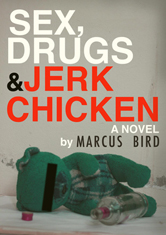 |
| The cover of Marcus Bird's novel |
Your book was promoted, launched and sold via Amazon and social media. From the initial conception of the idea through design & layout to the launch, what was your process for bringing Sex, Drugs & Jerk Chicken into the market?
The process of doing this mirrors a few campaigns I’ve worked on in the past. Since 2009 I’ve worked on a lot of trial and error methods to try and get exposure for my previous projects. What I learned was a few crucial things. One was that if you don’t tell people you are doing something they won’t know. You have to scream it, and shout it from the rooftops within reason. I love this quote I heard from American Fiction writer, Sarah Vowell recently. She said, “It’s a pretty megalomaniacal job being a writer, because you just assume that other people need to know what you say.”
This is so true. You have this concept, and this world you’ve created, and now you need inhabitants to live in it with you, people that will spend six to eight hours of their life in your mind, experiencing your journey with you. Initially it is easy to believe that people will want to go into this world with you, but that isn't the case.
What happens is that the next step is to ask, “How can I catch people?” or “How can I introduce them to this reality I’ve created?” So you need some basic eye candy with your book cover and title to make people curious. Then you have to figure out a way to generate significant interest for your project. I find interest tends to generate when you state expressly what you want to do to people. I’ve found that simply posting content online in this fast-paced world isn’t enough, you need to contact people before hand, let them know what you are doing, and see how they can help. Friends with good “people equity” (an established brand for example) are good if your goals align with theirs. Once they know what you are trying to do and why and then ensure they are there to help you. It’s not that people aren’t willing, but it’s a different story if you tell someone a successful book is your last reason to live versus “I wrote a book”. That’s an extreme scenario, but you need to nail the message on the head. A lot of people pushed my book for me in ways I didn’t expect. I didn’t even ask them to, it made me realize that if I had asked more people, I’d probably even have way more exposure right now across different avenues. Also, this book had a few things going for it. One was a really catchy title, two was a cool-looking cover and three was the surprise factor. I know a few people know I make films or do design. I think many people had no idea I wrote as well, so the interest would be even higher. ‘Writing a book’ in our present reality is a big deal, so some people get motivated to help you out. On launch day I probably had more Facebook activity than the last three years combined.
I also think an important thing is to have a lot of redundancy in what you promote, the same message everywhere. This helps keep people from asking too many different questions(which can sap time and energy). I started marketing the book subliminally for about a month. I had my Facebook cover photo as a picture of the bear with the empty bottle of liquor, taken from my novel book cover image.
The novel cover itself could be an entire interview. I went through several radically different designs trying to capture the vibe of what I wanted the book to say. Since a big part of my design style was “cute things “ I figured I could blend cute and decadent. A teddy bear, passed out with a hidden identity seemed perfect and fit with the title and also what I wanted to say about the book. Innocence lost, bad memories from the past, there are a million things a person can associate with the image, which makes it better.
The launch was just contacting a lot of people, making a video explaining what I was trying to achieve and giving them a date, plus a reason to buy on that day. I blasted this promo on Facebook, Twitter and Youtube and worked on getting a list of people ready to buy on launch day. Then I formatted the book in Microsoft word and published it through Amazon using the Kindle Direct Publishing program. I chose this because these days everyone has a device they can read on, and it would be easier for people to get the book this way even if they didn’t have a Kindle.
What's next in your plans for this book? What targets do you have for developing this creative project? Will we see a film, audiobook or webisode for eg.?
I want to be the Jamaican Hugh Howey. Like most people with a project like this, I actually want it to do well. What’s weird is that right now I’m not thinking like an artist, I’m thinking more logically about PR and trying to do better SEO (search engine optimization) for the web and seeing how well I can work with the Amazon marketplace. I see the book starting on the Kindle, and eventually going to print in the near future.
It is hard to really gauge what you think will happen from something you made up in your head. I think most writers who get successful are pretty shocked themselves, simply because of the way the odds work. I can’t say I’ve told myself I will sell millions of copies of this book. What I’ve definitely told myself is that the book is super marketable because of the title and the very attractive cover. I believe that alone will start to attract some readers. Then, I’m reasonably confident in my writing ability, so I know the writing isn’t terrible, or waning, and doesn’t drift here and there. The characters have issues, are interesting and conflicted. So I know these three key things are solid for credibility.
The only other real consideration is numbers. How do I get thousands of people reading so I can start seeing tens of thousands of downloads? I’m testing out a few things with Amazon to do just that. I believe with some good promotion and if Amazon pushes my book even once, it will become one of “those” books that do well.
I have a few plans in place for some tangential marketing around the book, but I need more time to think about it. A web series related to this book needs to make logical sense. So does a podcast. Do we talk about
Sex, Drugs, or Jerk chicken? It has to have a relative synergy.
To date I’ve done a lot of investigative video journalism in a simple way. I go to interesting places and occasionally talk to interesting people. Maybe I’ll do something where I’m chasing hot girls or something, but it has to be logical and fun. I definitely think a film can happen with the right team and budget, the world needs another D.C arthouse film!
What projects have you used social media to launch? How did it work out?
See more about this book project
here
Purchase the novel on Amazon
here




 Posts
Posts



