INTRODUCING

Christina Leslie's Portraits

N.L.S., A New Local Space

Deborah Caroll Anzinger's artist run residency and exhibition space in Kingston

ON THE SCENE

Leasho Johnson's Provocative Re-interpretation in 'Canopy Guild'

Light Sensitive

Marlon James' black and whites

Annalee Davis: ON THE MAP

Caribbean Political Documentary

Showing posts with label Edna Manley College. Show all posts

Tuesday, June 24, 2014

ON THE SCENE: The School of Visual Art's Final Year Show

Ramone Johnson, BFA Painting
The annual School of Visual Arts Show opened on June 7th. I haven’t seen a final year show at The School of Visual Arts for at least six years due to being away from Jamaica. During that time however there have been so many reports of surprising and promising work being shown. Some of that work has even gained so much notice that graduating students have been able to transition directly into curated shows at The National Gallery, attract serious critical attention and overturn expectations from certain departments.  For example, Visual Communication students were making work which clearly was increasingly engaging with interdisciplinary practices and global art histories. Painting students were recalibrating what being a painting student means and Sculpture Department saw a growth in interest from incoming students thus building an energy once more.   
This week is the last week of Edna Manley College’s School of Visual Arts Final Year Show and if you haven’t seen it here are a few reasons why you should:


Ramone Johnson, BFA Painting
Ramone Johnson (Painting) -
This room is filled with walls of wood and glass boxes reminiscent of the stained glass of local Catholic and Anglican church architecture. On closer viewing, snippets of newspaper articles documenting Jamaica’s political and social problems.


Stephanie Channer, BFA, Visual Communication
Stephanie Channer (Visual Communication) -
This room is a quiet contemplative but cozy space dedicated to her creative brand ‘i&i’. The space is also lined with posters reflecting the philosophies of the brand.


Necon Bailey, BFA, Jewelry
Necon Bailey (Jewelry) -
This space feels like a side gallery in a small museum. There were several original remakings of classical stringed instruments. There was also a little table of items made as memory, documentation, altered tools from daily and traditional local culture eg. the machette etched with drawings on both blade and handle.


Natali Daley, BFA, Visual Communication
Natali Daley (Visual Communication) -
The work in this room while being large and commanding has a jewel-like surface with applications of various patterns to various religious iconography. The juxtaposition of the images is the trick to finding some of the more political meanings in the images.


Kareen Weir, BFA, Sculpture
Kareen Weir (Sculpture) -
Very daunting prospect to be in a room filled with contorted faces that are human size. They  don’t intimidate however but rather attract viewers. They are something very interesting to see.


Traci Wong, BFA, Sculpture
Traci Wong (Sculpture) -
Described by one visitor as a ‘beautiful room’, the metal wireframe sculptures are large yet delicate at the same time. They are like solid 3d drawings. This work is really about spatial relationships and play with materials.


Lowell Roger, BFA, Visual Communication
Lowell Roger (Visual Communication) -
A space made from plyboard but the interesting part is the charcoal drawings of mythical creatures engaged in battle. Tattoo design, fantasy film genre such as ‘The Lord of the Rings’ and Asian art all come to mind.


Yannick Pinnock, BFA, Visual Communication
Yannick Pinnock (Visual Communication) -
The artist, influenced by Matthew McCarthy's work of a year ago, uses graffiti, cartoon, street art as a platform. He developed fictional characters, ‘Lionz’, which go about daily life all over the city of Kingston.

I went to see the show on a Friday at mid-morning which perhaps explains the very quiet and almost deserted feeling of the building. Not many students were around to engage with and many rooms were closed or lights were off. A suggestion to the school to solve this is perhaps to assign a few students to act as docents for the whole show for visitors who may need information and assistance.

Don’t let this deter you however as what rooms I did see were on the most part impressive. The energy that I saw from many of the students mentioned is very promising. I think it indicates that more importantly than departmental divisions and trying to define a discipline anymore is earnest investigation, openness to multiple influences, cultures, practices and a commitment to honest exploration. A fresh crop of creative thinkers and practitioners is definitely something that Jamaica could use now.

The show runs from 11am-7pm during the week and 12-5pm on Saturdays. To find out more contact Edna Manley College’s Cage Gallery or email them at cage.gallery@emc.edu.jm

Saturday, May 17, 2014

ON THE SCENE: Theatre tackles Science in 'HeLa'

Adura Onashile performs solo in  HeLa
The HeLa cell has been a major component driving the major scientific research and advancement in the last sixty three years. The particular qualities of the cell to grow rapidly and it’s resilience has made it an invaluable component in over 90% of scientific labs worldwide. If we think about the scale of which the HeLa cell has had an impact we can think of research in the HIV vaccine, In vitro fertilization, prescription pharmaceuticals, genetics and cloning. This is however a list of facts which you could find in any search engine a few clicks away. We often think about and even more importantly hear about Science in this way.


The HeLa cell in its very name carries with it a more personal but troubling story. It is this story which British-based performer Adura Onashile gave a powerful treatment in her one woman play, HeLa. The name HeLa comes from the hospital lab’s abbreviation of the name Henrietta Lacks. Lacks was an African American woman who was diagnosed with cancer at a hospital in 1961. The other part of her story is that a cell sample was taken from her during her treatment without permission thus beginning the story of the HeLa cells in scientific research. From that moment, even though the course of modern science was set on a path of rapid and highly innovative discoveries enabled by the HeLa cell, the family of Henrietta Lacks was set on another. Onashile in her composed and convincing portrayal of Henrietta’s daughter, Henrietta, The Narrator, The Lab Technician and other characters, relayed how the family have constantly questioned and sought to protect and reclaim the ‘spirit’ of Henrietta as she lives on in some form through HeLa cells worldwide. At one point, we realise via one of the characters that Henrietta Lacks is the only human to ever have more cells outside her body than inside it.  

The dramatic imagery  & sound of 'HeLa'
Various questions of the ethics in conflict with the ambition of the field of Science come in to play. Onashile’s voicing of Henrietta’s daughter finds her thinking about the cells as pieces of her mother who was exploited by her own doctors. In other segments of the performance we see images and video projected of the various Nobel Prize winners whose research and scientific discoveries depended on the use of this immortal cell line. Many of the issues raised are not new questions, as those of us paying attention to worldwide news would be familiar with the issues of ethics involved in the manipulation of nature involved with scientific research such as Stem-cell research. What ‘HeLa’ presents is an argument for humanizing and reconsideration of how Science’s race towards advancement occurs.


The history of The HeLa cell line is delivered to the audience
The performance was pared down with elements of multimedia, dance and the set working to present a sometimes abstract and sensory and at times clinical experience. Onashile managed to step back and forth between place and time notably by her use of various regional accents and use of a small number of props such as a large chalkboard recounting the names of scientists benefitting from the Henrietta’s cell line. The performance was followed by a Q & A session which left audience members with the beginning of a dialogue about the issues. Eventually though you ask the question, is it ok that the HeLa cell was taken because of what it has contributed; or does the greater good of scientific advancement trump individual rights? 

The play was sponsored by The Jamaica Cancer Society and staged at Edna Manley College of the Visual & Performing Arts. It was directed by Graham Eatough and inspired by ‘The Immortal Life of Henrietta Lacks’ by Rebecca Skloot.

Tuesday, April 8, 2014

The Importance of Social Art Spaces

Students of the Time-based Media course at Edna Manley College participate in a studio visit at NLS
Over the past three weeks I have had the opportunity to engage in different ways with the new local space, NLS. The space has been active for about a year and is run by Deborah Caroll Anzinger and a small team of volunteers. With each visit a new opportunity presented itself to the various hats I wear as contemporary artist, art educator and arts writer among other things. On my first visit I had the chance to meet the newly arrived artist participating in the residency programme, Rodell Warner.  There was also the chance to present my work to visiting curators and catch-up with other artists.

Local artist, Leasho Johnson talks about branding, sexuality and identity in his current work
On the next visit there, just a week after, myself and other artists had the chance to have discussions about trends in art, the local art scene and look at each others work. The interesting part for me was that even though as local artists we were familiar with each others work, this more intimate, personal and social setting was a rarity. There was the realization that as artists we mostly ever saw each other's work when it was already smoothly projecting the aura of 'Art' after being mounted in national and international exhibitions. We never had public chances to see the developmental stages and phases or to listen to the background and ideas of the work. What occurred to me was that we mostly understood each others work as exhibition items or tools to win curatorial, institutional and public favour and notice. This second visit to NLS made me ask the question as to why local artists didn't meet to discuss and show their work to each other more often. If like our Tourism industry we only ever maintain links with the external purveyor of our 'goods' then an element of non-sustainability and risk of exploitation may creep in. 


Visiting artist, Rodell Warner, explains development and technical processes in his work to students
 That visit pushed me to make an appointment to have my current class of Time-based Media students from Edna Manley College make a studio visit with Warner. This past week the students took an approximately twenty minute walk over from Edna Manley College to NLS at Mountain View Avenue to listen to Warner's presentation. The proprietor, Anzinger began by introducing students to the micro-gallery/ studio and outdoor yard which form NLS. We heard about the yearly curatorial programme and open-call submissions from artists as well as the local and global initiatives being encouraged. The presentation once again fueled questions as to how the art scene and creative industry locally and regionally would be affected if more little hubs of small but active local spaces like NLS were to start-up. It is encouraging as Gallery 178 downtown has also recently had its first committee meeting so good things should be in store. There are undoubtedly many more local spaces and groups but the interconnectedness with each other and public awareness is thin and thus makes these spaces sometimes difficult to access. It can only create a healthier cultural environment if multiple independent spaces, encouraging social interaction and supporting creative practice were operating. The result might lead to the much needed diversity and counter-balance to often all-encompassing and sometimes exclusive state-initiatives for creative industries and The Arts.

Have you interacted with NLS or are involved with another independent initiative which facilitates local creative practices?


Wednesday, February 5, 2014

Stefan Clarke :Artist Talk's at Edna Manley College

Stefan Clarke explains his work during an artist talk at Edna Manley College

Edna Manley College's School of Visual Arts (SVA) has a semester long programme of talks designed to stimulate both members of the art community and students alike. On select Thursday afternoons from 2pm to 3pm, a selection of SVA's faculty will be presenting their work and engaging in dialogue with the audience. Last Thursday's talk showcased Stefan Clarke's work which uses a combination of labour intensive processes involving Sculpture and Photography.

He spoke passionately about the sweet spot of his work lying in planning, staging and construction of his spaces, body armor and image-making.  He also described his constant involvement in both public commercial work and commissions and its importance to funding his more personal conceptual projects. His involvement in the design and installation of spaces for major local party and session events are equally as important to his practice as his metal work fashion pieces and digital photography.

Clarke, a particularly society-challenging artist, facilitated discussions which encouraged students to take more interdisciplinary approaches, self-teach dying techniques and to constantly stay curious and excited about creative practice. One of the issues he bemoaned was the constraints of finding models open to participate in the creation of his photographic images in a conventional society like Jamaica.

Upcoming talks will feature The Sculpture Department's Jeff Menzies. To find out more about this series you may get in touch with co-ordinator Katrina Coombs.

Friday, February 19, 2010

Remembering Kumina


Its funny, though I am a visual artist, I cannot remember going to museums or galleries as a child. The dress-up occasion for my family was going to see the new Pantomime in December and attending the National Dance Theatre Company’s (NDTC) Season of Dance. Though I drifted out of touch with it during my high school and college years my memory was renewed in 2008. Now 17 months in Japan, one of the last cultural events I attended in Jamaica was the NDTC Season of Dance. The performance was more vivid and emotive than I had remembered as a child. I am not sure if it was because I was now better able to appreciate the sounds, the movements, the posture and colours or if it has been refined into a fine art over all these years. I am sure it must be both reasons. In particular I am thinking of the performance of ‘Kumina’.


I only saw Rex Nettleford perform ‘Kumina’ once and then after that each year of seeing the performance I would be reminded by my family that the new dancers were doing ‘Rex’s choreography’. For me that was how the myth of Rex Nettleford began. That 2008 performance was revisiting for me one of the most powerful dance performances I have ever seen. I remembered in those minutes why I began engaging in cultural activity. I have to say that the dancers performing 'Kumina' now, contribute much to the power of that piece. I cannot remember specifically what Nettleford’s performance was like as at that young age as just seeing dance was overwhelming enough but I felt something of an aura still present there in the frenzied drumming, whirling skirts and strong faces. I remember asking during my NDTC attending days how do the dancers know how to do 'Kumina' perfectly each year. As a family of dance outsiders, I never got what I thought was an adequate answer. Perhaps it is just a sign of the strength of the NDTC that I can still wonder this today.


Photos by Peter Ramsey

source: www.bahamasuncensored.com


University of the West Indies Flickr Archive

source: http://www.flickr.com/photos/theuwi/

PHOTO COURTESY THE UNIVERSITY OF THE WEST INDIES. PHOTO BY VALDEZ BROOKS

Friday, October 2, 2009

VISUAL ACTIVISM: Phillip Rhoden's viewpoint


concept for "High school Drop out"

Phillip Rhoden was among the recent group of final year students mounting their final exhbition at The Edna Manley College. His body of work was pointed out to me as making a particularly individual statement about contemporary image-making. He seems to point to a newer directions at the college where the ideas approaches are interdisciplinary. In a year where you have a Visual Communications student having a 'painting exhibition' and a Fine art student  exhibiting an animation Phillip's statement about his artistic approach sheds some light.  

'Visual Activism, is when a person or a group of people, use their artistic abilities to create a series of visual campaigns, to spark social awareness or social change. Visual activism is not just limited to the Visual arts.  Music Artist can also be consider as Activists as well, as long as the underlying message is geared towards highlighting or speaking out against something the artist see’s wrong in society.  Activism plays a very key role in art, as art sometimes provides a way of communicating to people of different nationalities and religions; the way how you see life, problems you face because of your social surroundings and how you feel about them and what change you would like to see. And through art social boundaries such different languages are diminished as Art serves as a universal tool of expression. 

...I have to be very selective when I'm deciding which client, I will use activism as my approach. I find that company's such as Red Bull, to be the most receptive to the use of activism as means of marketing, but it has to be done in a way where its marketable to broad audience without stepping too hard on anyone's toe.

In terms of its role in the art community? I see visual activism as the Spies of Art, just enough of it will make things feel and taste just right. But when its over and done and been thrown in the face of the public on a daily basis, it begins to have a harsh taste, so people try to avoid it. Cause when you take a dirty attribute of society and make it beautiful. You fine that through that artwork, you offer a means of realization to the public without the waste of words.

-edited from an online interview at The ART:Jamaica Facebook Group page.

Tuesday, March 3, 2009

National Biennial 2008: O’Dwayne Wilson


Interview by Peta-Ann Smith, Jan. 26, 2009

PS: Based on your displayed work, the figures appear to be dressed as high-ranking Catholic clergymen. Did the fairly recent child abuse scandal that rocked the Catholic Church inspire this particular piece?
OW: Yes the recent events have influenced me to do works examining the role of the clergy and religion on a whole. But then what really did it for me was the film ‘Deliver us from Evil’ which was a biopic on a clergy man who molested kids at whichever church he went and the cover ups surrounding it.

PS: Did the subject matter of the work influence your choice of media? If so, in what manner?
b) If the subject matter bore no influence on choice of media, what inspired you to select these particular materials rather that use traditional canvas?
OW: Yes it did to an extent, the cloth, wood and the nails where all symbolic of the Catholicism. However the wood was mostly found due to constraints in the project and to off- set cost of the work. The wood was lying everywhere especially since the school was under going minor constructions. So I made use of what my environment could afford me. The cloth was also was interesting experiment in it self.

PW: Given the controversial nature of the work, especially when one considers the events of the past five years, do you think you'll revisit this subject in future pieces?
OW: Yes I would but it would be used as sort of linkages between ideas. Besides there are so many dimensions to the topic and a historical context which I feel could be explored more in depth. But I wouldn’t want to replicate the same works again in terms of the structure and forms that they took. I believe that the works would have worked better as an installation.

PW: Have you considered other themes and/or subjects that you would like to explore in your future pieces? If so, would you be willing to give us an idea of what you'd like to examine next?
OW: Hard to say ... the current financial situation of the world is always a stimulus because it affects every one on so many levels.
What I am watching right now is the conflict in Gaza and how that plays out. It has more effect on me right now. The battle happening there is a historic and an old one and has not been resolved for thousands of years. But its hard to say right now. But I am interested in doing a piece focusing on issues closer to home.

PW: Apart from different subjects, are there any media that you'd like to utilise in the future? If so, which media do you think will be the most challenging and possibly the most rewarding?
OW: I’ve always wanted to do digital media because of ability to be visually agile. It can enable me to explore a range of issues and techniques and maybe even venture into filmmaking.

Friday, February 15, 2008

State of the Arts: A Letter from Christopher Gonzalez

An example of Christopher Gonzalez's work from www.harmonyhall.com

When ART:Jamaica sent out its first e-newsletter in November 2007,we received a an email from Christopher Gonzalez, famed Jamaican artist, speaking about many timely issues within Jamaican contemporary art. I then assured Mr. Gonzalez that this blog was founded to promote the under-reperesented, whoever that may be. We do however focus on contemporary art as we want to help develop a culture once again of the same passion and openness that existed in the early days of the Jamaica School of Art in the Seventies. Mr. Gonzalez raises many issues which link to the history and nature of the way art has developed in this country. We welcome dialogue and invite you to engage in a discussion. His letter follows below.These views do not necessarily reflect the views of ART:Jamaica


Hello,
What is contemporary Jamaican Art ? Is it a take off from the American Art contemporary , where any freaky cocaine Art is accepted ? How in the world can we be influenced by this " Bastard culture ", " This Commercial Harlot" Can someone tell me this ?
In what way can " timeshow design" assist the development of Art in Jamaica ? Will they lobby with the Government to establish a Policy to protect the Arts and the Artists, since they do not listen to us for years now? There is now an upsurge in the interest of the Arts and I wonder if it is really genuine and sincere, or they have awaken to the potencialy mega-earning power and want to rob and exploit the Artists again as they have done over the years.

The Great King Pin of NCB instead of supporting the Jamaican Artists , he supported the" Large" Kingston Art collector.......... making that collector more wealthy . I am one of the Artists he has exploited . Twenty years ago I wrote a letter expressing my disgust in his attitude to artists. He has not bought a piece of thumbnail sketch from me since.

The Artists are the ones needing support, not the wealthy Patrons ! His brother keeps sponsoring Artists under 40 years old . This has always been the way here in Jamaica, delete the older Artists and promote the young ! This is dreadfuly wrong ! I remember as a young Artist , they droped Alvin Marriot and gave me a public commission because they could exploit me in terms of price. The first real public commission I got was the portrait of William Gordon, they paid me $100.00 Jamaican. They could not pay Marriot that figure !

I saw the show , "Young Generation" I got a bit confused , since I felt I was somewhere in New York or California. The Art reflect absolutely no Caribbean flavour or feelings ! Someone in the Gallery, on the afternoon I visited , said , " Art is Universal" Yes ! I agree , but it should carry Identity ! Please do not misunderstand, I am all for experimentation and exploration in contemporary imagery. More than twenty years ago , I taught a class in Three dimensional
design at The Edna Manley college( at that time, The Jamaica school of arts ) it was all about experimentation , but not to the cost of identity ! Maybe, this is the way of the 21st century , delete all aspects of Nationality and Identity and become a non entity in the so called "Global Village".........................

We really need to look into this trend of ignoring the older Artists for the young, remember , the older Artists paved the way for these younger ones and they have suffered much exploitation and disrespect in the past and still experiencing . Why the "King" don't sponsor at the end of the year, a show for Artists over 50 years old and put up 1.5ml. as first prize ? Are we like old books that you put in the store room and take them out when you want to give them a token award ? The same thing will happen when these present young Artists reach over 40 or 50. This is wrong , wrong , wrong !

Another negative this does is to create division betwwen the young and older Artists , giving the younger ones the illusion that they are more progressive and the older ones nonprogressive, stagnant, not contemporary........The young Artists have never invited me to their show( one or two may do it) The Mutual life Gallery clearly told me , the Gallery do not invite Artists, it is left entirely up to the exhibiting Artist or Artists. Is this healthy ?
Best regards !


Sincerely ,
Christopher Gonzalez

Do you agree or disagree with this letter?; What has your experience been as an artist, collector or agent/dealer/curator/art lover etc.? What steps can we take to ensure inclusion for artists and their rights. Is it a collector-driven system and if so, how has it shaped the arts in Jamaica and what are its advantages and disadvantages.

Saturday, December 1, 2007

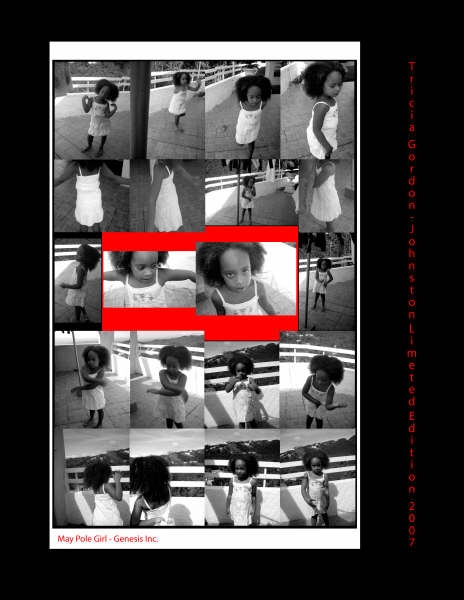
Tricia Gordon-Johnston: Balancing commercial and fine art practice


Tricia Gordon-Johnston is a practicing fine artist and recent graduate of Edna Manley College. She has exhibited in integral shows such as Curator's Eye II at The National Gallery in 2006 and SuperPlus Under 40 Artist of the Year 2006 at The Mutual Gallery. She currently does digital and photographic commercial design work alongside her artistic practice- not unlike many Jamaican artists. Her studio work however has been rooted in the conceptual tradition of feminist art and the tactile modernist work of various Latin American artists. ART:Jamaica has asked her to share some of her experience with balancing what has traditionally been thought to be conflicting forms of art.
Q. How do you balance art practice with your commercial work?
A. I think there is always a duality between Fine Art and Commercial work. Finding the balance, or the key must be in viewing both as art practice and contributing to our work each day, it is after all a way of life, as Petrona Morrison and Cecil Cooper used to state to us at The Edna Manley Collage of the Visual and Performing Arts.

Q.How did art college prepare you for real world survival?
A.College prepared me for the real world by both teaching me and reminding me that our vision of the world is what informs what we see from any perspective, if it is all beautiful, then it is all art, it's also what we make it.

Before I studied at Edna Manley Collage, I studied Business and Marketing. Now, as a practicing artist, I incorporate all three. The target market is also the audience, each possibly willing to purchase our version of our identity, as we project it on to a canvas.

I think our creative headspace is a Conceptual Space and not confined to a box, perhaps three boxes. I suppose the three boxes would be The National Gallery, the Mutual Gallery and of late I have also been thinking about The Cage Gallery. We each, I think bring something powerful, meaningful and excuisite to the table.

Also, when I sit at any table, I look and listen for live performance, that is what always transitions, for me, a circular table into a square of open-ended possibilities. I have also sat at many tables around the world and what makes me Nationalistic is both the way we fit in and stand out, internationally. Our Cultural 'flavour', if you will, is like an energy wire that connects us with consistent threads.

The fine arts are much like the fine art of everything. It may be an acquired taste, but if it ages like fine wine, then our identity is what reminds us that we have already done the healing an life is our Ackee and Saltfish, for the enjoy-ing.

Tuesday, August 28, 2007

UPGRADED SUMMER EXHIBITIONS


Having seen two of the major juried shows this summer, the JCDC Fine Arts Festival and the Under 40, it is obvious that a handful of curators and arts administrators are really trying to reposition Jamaican art internationally by improving exhibition standards prevent the formation of a status quo and give it a swift jumpstart. The guest speaker at the opening of The SuperPlus Under 40 Artist of the Year Exhibition, Taynia Nethersole spoke of defending the reputation of Jamaican contemporary art. She mentioned the declaration of one collector in stating that art in Jamaica was stagnating. Imagine that. A breakaway from convention and focus on experimentation and cultural exploration as seen in the works of young artists such as Cleve Bowen, Kereina Changfatt, Paula Daley and Oya Tyehimba, being declared stagnant. Being a young artist myself that statement is a bit of a slap in the face signalling the loss of the faith in young artists that collectors of previous generations had. This is reconfirmed by one of Jamaica’s most prolific collectors, Wallace Campbell, in a recent interview stating that he rarely collected work from young artists however promising. Is this possibly why so few contemporary artists are barely able to earn a minimum from their work or curated contemporary art shows such as the Curator’s Eye receives a scanty amount of visitors or contemporary artists have to prove commercial viability before being able to book a show at top commercial galleries. Quite possibly, and it is a fact the art community has to live with and I suppose somehow we all get on with it. This resilience carries forth in the work that is out there in the galleries such as The Mutual Gallery and the The CAGE Gallery; the continued encouragement and growing quality of art coming from youth artists, self-taughts and art students by the Jamaica Development of Culture Commission.

I must say however that great encouragement comes from the publication of a very well designed and edited volume of The Jamaican entitled classically, ‘The Art Issue’. If my memory is right, it is the only publication to cover so wide a span of Jamaican art in a few years. It may be a bit pricy for the average student or struggling artist but is well worth it at a price of $850. It could just as well be entitled ‘The Intuitive Art Issue’ or ‘The National Gallery Companion’ as it does give the most space to a timeline similar to the curatorial schema of the National Gallery’s permanent collection and the idea of the Intuitive artist. The general avoidance of new directions in our contemporary art, concerns me a bit. I would have loved to have seen a bit more about artists working with printmaking, assemblage, video, photography. fibre arts, performance, drawing etc. Later in the volume however,features on Christopher Clare, who peeked our interest in The National Gallery’s, Curator’s Eye II and Laura Facey’s under-publicized Institute of Jamaica show were included.

Before closing, I am mentioning an item on my Christmas list for the Jamaican art scene: the renaming of the SuperPlus Under 40 Artist of the Year Exhibition/Competiton. Since it is modelled on the Turner Prize, which has since evolved into a brand partially because of its name which is now comparable to the Oscars and Tony’s, why not employ some of its publicity generating strategies. A brand-worthy name is priceless as evidenced by The Art Issue.

Note: For artists who are not yet aware the National Biennial’s Juried section has been merged with the JCDC Fine Arts Festival so next summer presents an opportunity to enter work once more when the JCDC sends a call to artists.
Also remember to see the Under 40 show at the Mutual Gallery and vote for your favourite body of work. Their artists talk is Tuesday August 28th, 2007 at 6pm.

Because I am sure I have stepped on toes feel free to voice your opinion by posting your comments.

Link to a related article in The Sunday Gleaner:
http://www.jamaica-gleaner.com/gleaner/20070826/arts/arts1.html

Monday, June 25, 2007

Confronting Persona’s and Bodies


A walk through the Edna Manley College’s 2007 final year show, particularly the fine arts department, and the body emerges as a general concern. Figures and bodies have always been a part of the imagery produced by exhibiting students but this year’s show seems significant in a sense that in its focus on how we image ourselves and others it seems the dissatisfied descendant of established Jamaican art. The number of confrontational bodies and personas seem also to indicate an underlying direction in contemporary Jamaican painting. These young artists seem to have absorbed and digested the various schools of thought on how to deal with the body and its identity.

Sheldon Clayton, shows the influence of Omari Ra and also Black-British artists such as Keith Piper. Being confronted by the double-headed, young and definitively black male seems both a confirmation of the expectation of threat as well as statement of existence. Nevine Salmon has also presented her own head as a confirmation of self with a work stating that ‘Self is the fact that I exist’. This presents a powerful statement coming from the Ceramics department, in which she attempts more than the expected mastery of media.

Nicole Harris also uses her own image but as a seemingly down-trodden, dollish life-size plaster-cast. She presented various versions of the figure going through transformations while remaining the same. Reading this work could lead us to think about the gender inequalities women face in our society, art etc. Beauty and feminine identity also seems a concern for her in the very precious way the casts are painted. This idea of feminine identity takes on sexual and grotesque tones in Gretel White’s work. Through her canvases she morphs and flickers between turtle and girl with the images paying particular attention to her legs. At some point we are presented with a turtles head hanging like a limp phallus between her bent legs. In front of her paintings I felt like a moth before a flame, looking felt politically incorrect but the imagery was too intriguing to look away.

Brenton Campbell in this sense, was not as much about presenting an intrigue as much as he was about presenting. In several paintings he presented comparisons and foreshortened views of shiny ‘plasticky’ or sketchy bodies. ‘Slim’ was expectedly contrasted with ‘Fat’ in a manner that reminded me of an architects 3D projection of flat drawings or Renaissance drawings plotting out perspective. His manner of working seem s directly derived from artworld superstars Lisa Yuskavage and Jennie Saville. His being male, I ask the question on the appropriateness of painting the objectified female body which would relate him more to the American artist John Currin. The sensual emergence of the female form is achieved in some of Monique Barnett’s paintings. The nude emerges from the paint in a way that gives the impression of the artist herself struggling to find a representation of her own image and an acceptance of its reflection.

The idea of the body as explored by canonized artist such as Ana Mendietta, Kiki Smith and Anthony Gormley is reflected in the space presented by Camille Chedda and Garth Daley. Daley draws silhouettes of bodies in rudimentary bread mixtures while Chedda draws larger than life faceless bodies, which are reminiscent of images of death and angels. She also presents us with a large female body, which seems to have appeared on her medium of choice, garbage bags, through torment. She has presented us with a female body, which is anything but sexual and thus points us in a direction to consider other issues surrounding the contemporary body. Again here as with Sheldon Blake, Garth Daley and Nevine Salmon, black and white is a deliberate palette choice. This seems to be a revisit/ resurrection/revival of the black as colour idealogy as a ploy to reclaim black as a conceptually loaded colour.

Ainsworth Case presents neat and tidy depictions of decapitated and objectified female and male bodies. Case seems to also be this years torch-carrier of the new figurative school of painting which has slowly been emerging from the Edna Manley College; going back to Khary Darby. Each year since Darby’s show I have watched the new members of the school explore personal and social issues through neoclassical depictions of cyborgs, iconic renderings of youth, the development of personal sign systems and loaded art historical reference.

Azariah Clarke interestingly exhibited in a room apart from the other fine artists as though he could anticipate his separation from the overarching concerns. His motif of masks became decidedly graphic and modernist in their genuine pursuit of formal concerns such as colour, shape and space. He presented a mixed media piece however that revealed the presence of a gas mask with black male faces pouring from the region of the mouth-piece. Gas mask generally not playing a large part in Jamaica’s history makes me think of the Holocaust and perhaps he is inciting an awareness of a black holocaust or similar oppression of the black male. Either way it is an interesting and chilling image for me in particular.

Joel Clayton’s shallow spaces seems to exist somewhere between Sheldon Clayton’s strong statements about self and identity, the sweetly pastel colours of Monet and the new breed of African-American painters such as Kehinde Wiley who devote themselves to representing the persona of the contemporary black or ‘urban’ male.

Before closing, I wish to note the similarity in themes and language indicates to me a common concern for the young artist or maybe the young Jamaican, There must be a particular concern and alertness to: a) the frustration of building a career as a contemporary artist in Jamaica, (b) the current terrors and tragedies of the globalised world (c) the struggle for Jamaican art to define itself in the contemporary at arena (d) the contemporary concern with the individual body and its shifting and redefined boundaries

The specific works highlighted in this article are in order to support points and are not intended as a statement of value or merit. The show will be presented as part of The Art on the Edge Festival at the Cage Gallery at Edna Manley College on Tuesday 26th at 6-8pm. Presented will be the work of other interesting graduating fine artists such as Marvin Bartley and Russell Gunning.

Monday, April 23, 2007

Time-based Media?

What is Time-based Media? Why is 'time' an issue of importance in digital media and the contemporary artist? Why is it relevant to the arts and artists in Jamaica? What qualifies a medium to be placed in this category and is it specific to medium or is it more of an approach or aesthetic? How does it function in the fine arts as opposed to the commercial industry?What applications has it been previously used for and what potential does it have for our cultural industry? What about the creative process differs from using non-time-based media and does it allow for intuition and inventiveness? Should its value as a product be different from that of other media?

Monday, March 26, 2007

A Report: Rape, Rudeness and Renee Cox


The first research symposium at the Edna Manley College was held last week, with the highlight being the appearance and participation of controversial New York artist Renee Cox. Cox gave an artists talk to keen students and staff amongst book shelves and tables in the library. She was very animated in her delivery garnering frequent laughter from the audience. The level of intimacy achieved with the audience was such that students lacked no reserve in questioning and speaking to the artists. Foundation year students were moved to comment multiple times and a final year student made reference about the artists ego as being integral to his enjoyment of her work. Cox spoke about problems with how her pregnant body was viewed by the art world and society as being the driving influence behind the 'Yo Mama' series. She even provided a 'sneak peek' at new work which is inspired by 'Desperate Housewives' and the St. Andrew upperclass housewife set. The driving influence being the need to create images where black women are given the space to 'luxuriate in depression' . She also spoke of her controversial match with ex-Mayor Giuliani back in 1996, referring to the former mayor as a greasy-haired Italian with a bad comb-over who knew nothing about Photography. In another mouthful, ignorant ebonics-speaking black women were also reproached for missing the message in her work and the intention of it being made for 'them'. This made me think about the commitment that artists have to make in using racial material in their work. Are artists required to reflect the politics in their work in their speech and lives? Should they be held as responsible as 'regular citizens' for their viewpoints and how important is intention to how a work functions for its public? Omari Ra answers this in stating in his presentation that he believed artists had citizens rights and responsibilities only and not specifically a free pass to do as he or she pleases.

On the Thursday, when the symposium began with Cox as the keynote speaker, I arrived just in time to hear her tell students to do first and ask later before descending the podium. An audience member noted that it was a more reserved Cox that presented that morning, perhaps due to the setting as an official research symposium.
Panel 1 comprised of Taynia Nethersole, Clinton Hutton, Marcia Hextall and Kim Robinson-Walcott and was the most comprehensive in its scope. Taynia Nethersole spoke about the law in relation to censorship as being very subjective. The basic guideline being that the rights and freedoms of the individual should not infringe on the rights and freedom of others or the public interest. She also spoke about the law being used to label an artwork seen as having no artistic value as being obscene. Concerns raised are that often persons call to make judgements about the artistic value of something are often not qualified to do so. An individual judges what is in public interest and not a majority therefore rulings are often personal matters and not necessarily rooted in the
'law'.

Clinton Hutton's take on the role of censorship in the arts in the Caribbean involved the cultural and religious censure of African slaves in plantation society. His vociferous quotations of ethnological texts was surely strategically placed to incite the black members of the audience to nod heads and cause the caucasian audience members to feel discomfort in their seats. His conclusion from his research was that whatever was considered white was beautiful and whatever was black was ugly. This ugliness and 'love of vice' was not curable by our own devices but had to be assisted through the colonizing powers thus the attempted erasure of African heritage.

Kim Robinson-Walcott gave a very entertaining talk which involved her doing a slow rap from the now popular Kiprich track mimicking Zebra and Tiger. She clearly stated that she enjoyed the beat of the music, calling it 'cute and catchy'. Her issue was not the catchiness but with a specific section of the song which described graphically and admittedly quite lyrically, the events of a possible rape. Her frustration then stemmed from attempts to have the song removed from the air waves to have the censured song re-appear with a beep at the last words of each line. This she did not find satisfying as any one could figure out the missing words. I say possible rape as a debate ensued about this. Was it rape or what Carolyn Cooper called a 'bait and switch'. Cooper was however quick to say that she was not defending slackness but looking at the possiblities of the song. Winston Campbell, who later presented on the Visual arts panel, chided Robinson-Walcott for taking the song out of the context of the mimicry of dancehall rivalry. This was countered with the general sentiment that context or not, a public description of a rape for entertainment purposes is never appropriate. This led her to her main area of Anthony Winkler's 'healthy sexual references'. Robinson-Walcott introduced a kind of binary system for measuring 'slackness' which perhaps could guide in the censorship process. 'Slackness' and obscenity could be 'fun' or harmful, meaningless or meaningful. Intention is apparently all. This again made me think of the issue of artistic license and freedom of speech. Does the title 'art' make slackness alright in society. Do artists use slackness and controversy as a poltical tool and what does that do to perceptions of art and artists?

On a last note Karl Fagan, a 2nd year student who presented a lengthy paper, must be commended for almost outshining several other presenters at the symposium. He obviously had an opinion and was not shy or rudimentary in his expression of it. Censorship functions within some of the very instituions who don a progressive self-image such as the Edna Manley College. Censorship of students for final year shows, censorship of certain ideas in certain courses and departments. To reference Winston Campbell, society seemingly cannot exist wtthout censorship as social groups do have rules and guidelines for appropriate behaviour. Is Censorship linked to power? Perhaps as Omari Ra suggests censorship is not linked to morality as such but political agenda. Do we judge the our popular culture, the dancehall, with the same code as, our high culture?

Sunday, March 4, 2007

NEW DISCUSSIONS:“CENSORSHIP AND THE ARTS IN THE CARIBBEAN”

The question of freedom of expression in the arts is currently receiving a lot of attention in many parts of the world. While many artists are pushing the limits of the acceptable, with deliberately provocative works, the public exhibition and support of their work has resulted in many controversies, fueled by new, or renewed, political and religious sensibilities and the enhanced exposure provided by the media. This debate has special significance in the postcolonial world, where the arts have conventionally been seen as crucial to the development of a more equitable society, or nation-building, and a confident sense of cultural self. This is evident in state-sponsored, independent and explicitly dissident artistic expressions alike. In the Caribbean, this moral-political imperative exists in uneasy tension with a well-established tradition of freedom of expression within the artistic community and subversive tendencies within the popular culture.
There have been several incidents recently in Jamaica that have given particular urgency to the subjects of freedom of expression and censorship and the arts. For instance, the controversy about a new Emancipation monument – Laura Facey’s Redemption Song (2003) in New Kingston – mainly concerned the nudity of the two central figures and its appropriateness to the subject. This resulted in vigorous debate in the local media about what is and what is not acceptable in public art, who should decide on how subjects of collective interest are publicly represented in the arts, and whether this differs from the fine arts in other, more private contexts. The provocative music, dance style and fashion of Jamaican Dancehall culture, on the other hand, have not only become dominant in the local popular culture but have spread throughout the Caribbean and its Diaspora in North America and Europe. This Dancehall culture is seen by its critics as socially counterproductive and therefore rightfully subject to censorship. Jamaican-style “Passa Passa” street parties have been banned by authorities in Barbados, Grenada and Guyana and there have been calls, locally, to curtail the use of indecent or abusive language, which is in any case illegal in Jamaica, and provocative, potentially physically hazardous dance moves such as the “Dutty Wine” at Dancehall events. Several popular Jamaican Dancehall artistes have also become internationally controversial because of their violently homophobic lyrics and this has led to the cancellation of some of their concerts in North America and Europe. Advocates of Dancehall culture have argued, in contrast, that it deliberately challenges middle class moral norms and is held by its critics to more restrictive moral standards than Caribbean “high culture”, such as the fine arts and theatre, where provocative content is more likely to be tolerated in the name of artistic freedom.
These Jamaican examples well illustrate that the subject of freedom of expression and its relation to the social role of the arts is central to the debates that shape the arts in the Caribbean and must be taken seriously by Caribbean artists, cultural institutions, the media and audiences alike. While the subject is receiving intermittent attention in the regional media and in some of the critical writing about contemporary Caribbean culture, there has been insufficient structured debate thus far that confronts the full range of viewpoints and the issues that arise in the different areas of cultural production. Nor has sufficient attention been paid to its significant implications for arts education in the region. The Edna Manley College, as the main tertiary educational institution dedicated to the visual and performing arts in the Anglophone Caribbean, has thus decided to make it the subject of its emerging research, public discussion and publication programme.
The “Censorship and the Arts in the Caribbean” project has two key components. The first is the staging of two symposiums on the subject. The first such symposium will be a full-day event held on March 22, 2007. This event will consist of a keynote address by Renee Cox, a prominent Jamaican-American photographer and performance artist who has personally encountered major controversy and efforts at censorship in response to her often very provocative work. The keynote presentation will be followed by three panel discussions, one in the morning and two in the afternoon, that will explore various positions on the issues at hand and allow for audience interventions. This will be followed by an open discussion at the end of the day. Each panel will have four panelists and a moderator, selected from Edna Manley College faculty and students and other artists, cultural administrators, media practitioners, religious spokespersons and cultural critics based in Jamaica. In selecting these panelists, care will be taken to represent a broad range of perspectives and issues relevant to the Caribbean and its Diaspora.
The second symposium will be a half-day event and will be held in October 2007, on a date yet to be determined. The main purpose of the second event is to revisit and reflect on the issues raised in the first symposium and to create an opportunity for the presentation of responses and alternate views. It will consist of a keynote presentation and at least one panel. Persons from the local or regional media, the academy, the art world, and the Church will be considered as keynote speakers or panelists. The discussion panel(s) will, as before, consist of four panelists and a moderator and will be selected from the same categories as the first panels.
In terms of audiences, the symposiums are mainly directed at the Edna Manley College faculty and students but, given the subject, should attract more widespread attention and participation. The symposiums will be free and open to the public and will be well-publicized in the local media.
The second component of the project is the publication of the papers presented at the symposiums which will serve as a resource for further debate on the subject. This will be done in a specially-themed edition of the Edna Manley College’s new arts journal, which will become an annual or biennial publication. This publication will mainly be circulated in Jamaica, for the benefit of the cultural, educational and academic communities here but the journal should also be available to overseas interests. It will be sold at an affordable, cost-based price to facilitate broad access. Distribution arrangements are to be worked out and may involve a local publisher or printed matter distributor.
- post contributed by Veerle Poupeye

Wednesday, February 14, 2007

Perverseness, Painting and Dante's Inferno:Interview with Marvin Bartley

This was a very bold thing for yourself and Camille Chedda to enter the National Biennial while still students. What were reactions to to this?
Well the reactions were varied but the underlying issues that aroused from the reactions of friends was that we should go for it, we all had our doubts and inhibitions as to whether or not we would get in. However it was generally all good.

You started off painting images on canvas but now you use digital photography, why the switch and how was it recieved?
Let me start by saying its acceptance was not great at all because of the value systems that people around me are used to. Example your expected to paint in a painting department so anything contrary such the photographs i now produce is unacceptable, i was even advised by many to paint the images that i produced through my photomanipulated processes. The images for them never really seemed complete in their photogrphic state. The reason why i switched media was the fact that my photograps were way more developed for my ideas that my classical painting methods ever were. Also it was for me a way of callenging the value system that has been set up by the society with regards to the value of painting over that of photographs and finally to engage myself in a much newer medium than paint.

You mentioned deriving some of your imagery from classic European artistic sources such as Dante's Inferno. How did you, as a young Caribbean art student, become attached to these sources?
Thats something i myself would like to know the answer for. Just kidding. I became very interested in classical imagery and literature in 2003 after seeing works from contemporary realist painters Philip Thomas and Andre Green who were just leaving and preparing to leave the college. There works dealth in a serious way with the classical techniques. Ive always had great respect for formalism and thats why i chose to look at classical references for my inspiration being that classical art is the backbone of formalism.

How do you feel your work which is now digital, sits within the kind of academic representational painterly tradition that has been coming out of the art school in the last few years? I am referencing of course young male artists such as Khary Darby, Phillip Thomas and Andrae Green.
Well I first of all think that it sits quite fine among their works with respect to the contemperary treatment of the image however it sits alone with respect to the process and finish. Khary, Phillip and Andrae all to me challenge simillar technical and formal issues that men have struggled for centuaries with, now i questioned myself as to why i would want to do te same thing when i have new media that i can challenge to gain new ways and approaches, so for me photo-manipultion is my main stay. Rest assured i have not abandoned painting with paint.

Being the first Edna Manley college student expected to mount a final year show wholly in digital prints, how do you think you will be recieved by the major collectors of representational paintings?
I wont try to predict responces but i can say this you'll all have one big surprise when you see what i now have.

Tuesday, February 13, 2007

Biennial 07: Invitation to Discuss

This biennial is a particularly important exhibition for various reasons. It stands out as being one of the first years where on can think of a set of artists being shown who utilise digital media and processes. Renee Cox, controversial New York-based artist is exhibiting several photographs and students from Edna Manley College are exhibiting alongside seasoned practitioners. There are many more questions that could be asked and discussed in response to the Biennial and I invite you to do so here. It is remarkable also that I have not seen as much publicity for such an immense exhibition. Which artists stood out for you? What does a show like this say about Jamaican culture and its industries? How does this show affect audiences? etc.