INTRODUCING

Christina Leslie's Portraits

N.L.S., A New Local Space

Deborah Caroll Anzinger's artist run residency and exhibition space in Kingston

ON THE SCENE

Leasho Johnson's Provocative Re-interpretation in 'Canopy Guild'

Light Sensitive

Marlon James' black and whites

Annalee Davis: ON THE MAP

Caribbean Political Documentary

Thursday, July 11, 2013

Sex, Drugs & Social Media


The author of Sex, Drugs & Jerk Chicken, Marcus Bird

A few months ago Marcus Bird described his experiences in Tokyo and the impact on his creativity. Now back in Jamaica, he has launched his new novel, Sex, Drugs & Jerk Chicken on Amazon. His journey is one of the creative today seeking to link the multiplicity of media and marketing tools available to reach audiences for his work. It is a story that is not foreign to many artists today who are trying to handle their own publicity and ensure that their work reaches the marketplace. He shares the source for this story and how he took the project from concept to actualization. Keep reading for tips and tricks for becoming a media savvy creator and ways of channeling your inspiration into creative content. 

The title for your novel Sex, Drugs & Jerk Chicken references the infamous song about the punk rock scene and decadent lifestyles of a particular sub-culture in the US at a certain time. Is this link to Sex, Drugs & Rock 'n' Roll of particular weight in your novel? What about the ‘Jerk Chicken’ in your title?

Just before the internet hit the real broadband stage in Kingston, my only easy access to international music was from shows like The Rick Dees Weekly Top 40 and The World Chart Show. I still remember hearing Alanis Morisette’s Ironic for the first time. I really vibed with that sort of introspective, angry music, and I think like most Jamaicans who were a little alternative, that was the inception of some of my future curiosities about other cultures.
Sex, Drugs & Rock and Roll to me is about raging through issues and life in a blur of bad decisions where you live to happily tell the tale. For most people Sex, drugs and ‘anything’ is a part of their life. People drink, people smoke, people have sex, it’s a reality. We all aren’t rock stars, but we all have decadent moments, we all make bad decisions and we all get burned. It happens sooner or later, and how people deal with it varies. This is how my book title really comes into play. Sex, Drugs and Jerk Chicken follows that line of exploration with the characters, just like us, where we occasionally dive into the shallow end of the pool and smack our heads on the bottom.
Jerk Chicken represents the Jamaican element of the book. The three main characters are Jamaican, they are literally the meat of the story, the “jerk chicken” so to speak. What else screams Jamaica like “Jerk Chicken”? I can’t think of much else.

Washington D.C. at night
You went to Howard university in Washington D.C...Does this story about three Jamaican guys in Washington D.C., come from a place within your own life experience?  
I think everyone has periods in their lives when things are revealed to them in slow bursts or all at once. A person close to you might die, a girl you love might cheat on you, you probably realize your career is going nowhere… all of these things can shatter the previous paradigms of life you held on to. There was a period of time when Washington D.C became very different for me. Initially I was insulated in the “student bubble” of Caribbean Student’s Association parties and hanging out mostly on campus. But during that time I had some issues with school and ended up taking about two years off. When I returned, most people I knew had already graduated, and I was this slightly older fellow in a sea of freshmen. So the city became my new friend; restaurants, bars, you name it. In the middle of all this noise, I started to see different sides of myself and the city around me.

Interactions with different kinds of people in different circumstances became more vivid and illuminating. Washington D.C has all these different areas, Northwest, Northeast, Southwest, Southeast, etcetera, but you also have your people who live in Virginia or Maryland and commute to the city, people passing through, school kids, lawyers and so on.  Then there are all these areas like The Mall, Chinatown, Adams Morgan and so on. In the book I create characters and scenarios that attempt to illustrate aspects of this D.C reality. I chose three characters because the strongest elements of this book; loss, isolation and searching felt like too much for just one character. I wrote about three Jamaicans because I’m Jamaican. It wasn’t an overt decision. My reality and experience as a Jamaican in most situations mirror the regular realities of other people and I wasn’t worried about anything involving authenticity.

In D.C I met tons of different kinds of people, including Jamaicans, and we all aren’t the same. Three Jamaicans in D.C is as plausible for me as three Irish guys, or three Ethiopians. What mattered mostly was their realities, and whatever situations they were in. As a writer it is also good to operate in a context that you are ridiculously familiar with, you so you get into certain nuanced perspectives on a character’s conflicts or issues based on say, something cultural, that you can really illustrate from personal experience.

Sketches for the book cover
At Howard, you studied filmmaking, How did you make the switch from filmmaking to designer to writer? How are you seeing these various roles as fulfilling your creative vision and how do they overlap and emerge separately?

I never actually switched. I say that because I was a writer first, before I got the filmmaker title. It’s funny how cyclical life is when you are a multi-talented individual, because depending on where you are, you might be using one skill for an extended period of time, but you still have a lot of other ideas burning inside you. I became a “filmmaker” technically after completing my Film Production degree at Howard University. Soon afterwards, I went to Japan and a few other countries and shot videos and spent some time fleshing that side of myself out. Now I was still writing on my blogs and for online publications, but definitely at the time, videography was more of a focus. What most people don't’ know, is that I wrote my first novel a while back, maybe eight years ago. Then, I was really gung-ho about being a writer, and despite doing a Computer Science major (which obviously I stopped) I ended up penning about four manuscripts over a two-year period. I wrote a science fiction work, a work about unrequited love, a novel set in Jamaica, and a non-fiction project. I wrote thousands of pages and pushed the limits of my desire to write.

I did all this operating within the framework of a system I used to see if I really want to do something.  Basically the system’s mantra is: if you can go to the near maximum extreme of a goal you are setting, you will really see if is something you want to do. If writing thousands of pages doesn’t tell you if you want to write or not, I don’t know what will. So, at that time, for a few of my projects, I sent out numerous query letters to agencies and publishers. After relatively mum responses from a few Literary agencies and collecting a ton of rejection letters, I said “maybe writing isn’t my thing right now.” The designer side of me emerged in between being a writer and a filmmaker. I’m a serious “ideas” man, and I always look at ideas as a balance between skill and execution. I thought a “designer” was a person with a design degree. But what I learned eventually is that a designer is a person with the skills to do design. I’ve always had ideas for web comics, t-shirts and characters, and I learned the skills to create my thoughts using Adobe Photoshop and Adobe Illustrator. So I also had a period when people called me a designer and were curious about projects that ran along those lines, so that’s why I said emphatically I never switched, I just developed a few core, very strong skill sets over a five to six year period in a few different areas.

All of this overlaps now in interesting ways. For the last few years I’ve worked hard at building a personal brand through experimentation. I made a few web series on Youtube, I wrote a bazillion essays on a few of my personal blogs, wrote for some websites, got published in a few literary journals,  designed clothing and even did some TV production. I did it all. In the midst of all these skills is simply function. Meaning, I’m able to think about something and execute it quickly relative to the project I’m working on. Because I can write, design and brainstorm it gives me a pretty insane workflow which I don’t think is easy to duplicate, but that’s how everything added up over time. What my skills allow me to do now is really look at an idea from different angles and accurately judge the variety of ways I can initially express it. When I was finishing Sex, Drugs and Jerk Chicken, because  I’m able to design the cover, I obsessed over that almost as much as the endings for the characters in the book! In fact there were many days I couldn’t even write, because I was working on different cover concepts and trying to match the feel of the novel with the feel of a cover image. Sometimes it feels like it's blazing in 3D sometimes, across multiple concepts, but I think the balance of skills I have allow me to give a different personal expression to my work, in the way a person with a small creative team would.

The cover of Marcus Bird's novel
Your book was promoted, launched and sold via Amazon and social media. From the initial conception of the idea through design & layout to the launch, what was your process for bringing Sex, Drugs & Jerk Chicken into the market?
The process of doing this mirrors a few campaigns I’ve worked on in the past. Since 2009 I’ve worked on a lot of trial and error methods to try and get exposure for my previous projects. What I learned was a few crucial things. One was that if you don’t tell people you are doing something they won’t know. You have to scream it, and shout it from the rooftops within reason. I love this quote I heard from American Fiction writer, Sarah Vowell recently. She said, “It’s a pretty megalomaniacal job being a writer, because you just assume that other people need to know what you say.”
This is so true. You have this concept, and this world you’ve created, and now you need inhabitants to live in it with you, people that will spend six to eight hours of their life in your mind, experiencing your journey with you. Initially it is easy to believe that people will want to go into this world with you, but that isn't the case.

What happens is that the next step is to  ask, “How can I catch people?” or “How can I introduce them to this reality I’ve created?” So you need some basic eye candy with your book cover and title  to make people curious. Then you have to figure out a way to generate significant interest for your project.  I find interest tends to generate when you state expressly what you want to do to people. I’ve found that simply posting content online in this fast-paced world isn’t enough, you need to contact people before hand, let them know what you are doing, and see how they can help. Friends with good “people equity” (an established brand for example) are good if your goals align with theirs. Once they know what you are trying to do and why and then ensure they are there to help you. It’s not that people aren’t willing, but it’s a different story if you tell someone a successful book is your last reason to live versus “I wrote a book”. That’s an extreme scenario, but you need to nail the message on the head. A lot of people pushed my book for me in ways I didn’t expect. I didn’t even ask them to, it made me realize that if I had asked more people, I’d probably even have way more exposure right now across different avenues. Also, this book had a few things going for it. One was a really catchy title, two was a cool-looking cover and three was the surprise factor. I know a few people know I make films or do design. I think many people had no idea I wrote as well, so the interest would be even higher. ‘Writing a book’ in our present reality is a big deal, so some people get motivated to help you out. On launch day I probably had more Facebook activity than the last three years combined.

I also think an  important thing is to have a lot of redundancy in what you promote, the same message everywhere. This helps keep people from asking too many different questions(which can sap time and energy). I started marketing the book subliminally for about a month. I had my Facebook cover photo as a picture of the bear with the empty bottle of liquor, taken from my novel book cover image.
The novel cover itself could be an entire interview. I went through several radically different designs trying to capture the vibe of what I wanted the book to say.  Since a big part of my design style was “cute things “ I figured I could blend cute and decadent. A teddy bear, passed out with a hidden identity seemed perfect and fit with the title and also what I wanted to say about the book. Innocence lost, bad memories from the past, there are a million things a person can associate with the image, which makes it better.

The launch was just contacting a lot of people, making a video explaining what I was trying to achieve and giving them a date, plus a reason to buy on that day. I blasted this promo on Facebook, Twitter and Youtube and worked on getting a list of people ready to buy on launch day. Then I formatted the book in Microsoft word and published it through Amazon using the Kindle Direct Publishing program. I chose this because these days everyone has a device they can read on, and it would be easier for people to get the book this way even if they didn’t have a Kindle.

What's next in your plans for this book? What targets do you have for developing this creative project? Will we see a film, audiobook or webisode for eg.?

I want to be the Jamaican Hugh Howey. Like most people with a project like this, I actually want it to do well. What’s weird is that right now I’m not thinking like an artist, I’m thinking more logically about PR and trying to do better SEO (search engine optimization) for the web and seeing how well I can work with the Amazon marketplace. I see the book starting on the Kindle, and eventually going to print in the near future.

It is hard to really gauge what you think will happen from something you made up in your head. I think most writers who get successful are pretty shocked themselves, simply because of the way the odds work. I can’t say I’ve told myself I will sell millions of copies of this book. What I’ve definitely told myself is that the book is super marketable because of the title and the very attractive cover. I believe that alone will start to attract some readers. Then, I’m reasonably confident in my writing ability, so I know the writing isn’t terrible, or waning, and doesn’t drift here and there. The characters have issues, are interesting and conflicted. So I know these three key things are solid for credibility.
The only other real consideration is numbers. How do I get thousands of people reading so I can start seeing tens of thousands of downloads? I’m testing out a few things with Amazon to do just that. I believe with some good promotion and if Amazon pushes my book even once, it will become one of “those” books that do well.

I have a few plans in place for some tangential marketing around the book, but I need more time to think about it. A web series related to this book needs to make logical sense. So does a podcast. Do we talk about Sex, Drugs, or Jerk chicken? It has to have a relative synergy.
To date I’ve done a lot of investigative video journalism in a simple way. I go to interesting places and occasionally talk to interesting people. Maybe I’ll do something where I’m chasing hot girls or something, but it has to be logical and fun. I definitely think a film can happen with the right team and budget, the world needs another D.C arthouse film!

What projects have you used social media to launch? How did it work out?
See more about this book project here
Purchase the novel on Amazon here

Saturday, June 22, 2013

ART:Jamaica Upgrade!


Thanks for your patience with this site and your support. During these last 5 years plans were being made to make this space more functional, consistent and forge new directions. With a staff of one part-time person some of these things take time to balance them with other life demands. The process of upgrading and reshaping the site has finally begun however so I ask your understanding while this takes place. Assistance is always appreciated. If you are interested in suggesting and or creating content for this space or contributing to the design of it as well as advertising here please feel free to make contact via Facebook or in an email or response to this post and we can talk. I look forward to your continued support.

Thanks
Oneika

Sunday, May 19, 2013

Imagine New Dimesnions in Jamaican Theatre


Storybook Theatre Productions have begun staging a nine-show theatrical production titled 'Imagine'. The show has various elements of theatre uncommonly seen on Jamaican stages. The production is more of a rolling montage of skits put together to make one performance. It is held together by the presence of signing performers in various stage positions throughout. 'Imagine' offers much to enjoy in sensory terms as well as it makes use of sound design, light effects, large scale puppetry, harnesses and suspension devices, animation technique, illuminating and fluorescent materials and mime.

Scenes range from choreographed tribute to the many phases of Michael Jackson; a gothic tale involving the illusions of time and space created by moving beautifully painted scenery panels; an underwater sequence reminiscent of Disney's 'Little Mermaid' but performed to 'The Yellow Submarine'; a mime involving french style tramps and-punchinello clowns; a highly dramatic old story time sequence; and a charming dream-like dance of an approximately life-size puppet girl and her dog dancing to Whitney Houston's much acclaimed 'I Believe the Children are our Future'.

The production is not without its flaws however as the connecting time between the various scenes could be further considered and a few other details sharpened. 'Imagine' is despite this, a unique experience within the Jamaican Performing Arts scene. It was in the second to last scene that the real message of the production was delivered: a call for society to respect, consider and use greater sensitivity to our hearing-impaired population. The message is of such importance that it is a shame that the tickets are not priced within the range which makes it affordable to wider audiences. It is said that the reason for the ticket price is the expensive overheads at The National Indoor Sporting Complex venue. The venue was used because it is the only stage in Kingston  large enough to facilitate such an ambitious production. There are also reports that the request to the country's private sector to sponsor and enable cheaper tickets has been poor.  The show could also be titled 'Believe' as it makes it believable that the diversity and innovation within the cultural sector is within reach.

Friday, April 5, 2013

New Caribbean Artists Residency


The options for artists in the Caribbean have steadily been increasing in the last few years. In Trinidad & Tobago, Alice Yard has become increasingly more active in the region with its 24 hour invitational residency. The Popup Studios in Bahamas also has become known for its Drawing Residency. In Jamaica, NLS has recently invited several socially engaged photographers to participate in their own residency programme. Fresh Milk Barbados, has now launched its own international artists residency.

Fresh Milk Barabados is a team of creatives including an art historian and a writer who are interested in political and social engagement via the Arts. The residency can accommodate two artists or writers simultaneously. This works well with the option to collaborate with local artists or amongst artists in residence. The space appears to be an idyllic island setting of wood floored studios situated under shade-giving trees. There are several facilities also included such as  use of the on-site reading room and wireless internet access.

To apply you need to fill out their application form, attach references and a portfolio. Find out more by visiting the link below for more details on residency costs and to make contact.

Have you been an artist in residency in the Caribbean? What was your experience like?

Fresh Milk Residency link here

If you would like to publicize your residency programme on this site please make contact via Facebook

Sunday, December 9, 2012

Thanking Petrine

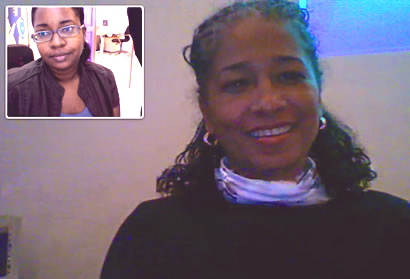
Skype screenshot from virtual Artists Talk with Petrine's Cornell Uni. course., 2006. Source Panmedia.com

Yesterday, I received the news that Petrine Archer-Straw had passed. This news dis take me by surprise. My connection with Petrine was mainly as a mentor for my artistic and academic work.  Throughout this period she showed great generosity in encouraging my artistic practice, academic pursuits and especially this blog. I first met Petrine when I had my final exams at Edna Manley College in Kingston. She was one of the examiners of my final year Painting Show. I remember her for insistence that I shouldn't settle for the easy pathways in my work.

Later on I had the chance to work with Petrine on her website Diaspora Dialogs by providing discussions and artist talks with her course at Cornell University. Throughout that time my interaction with Petrine as a young artist made me feel that there was something of importance in my work. When I last connected with her it was to ask her to be an external supervisor for my doctoral thesis in Japan. For administrative reasons this didn't work but she allowed me access to her writings to help guide the way for me. It therefore hits me with the weight of the news that one day after handing in said thesis that there will be no more chances to connect with Petrine.

I want to therefore thank you Petrine for encouraging and supporting me in my endeavors. I also want to thank you for contributing so much to the arts and understanding of culture.

Wednesday, October 3, 2012

What I found on Twitter: Tallawa

Screenshot from tallawacollection.com
I just found this website this morning where you can see designs like the one above. They have a new Spring Collection with really eye-catching textile designs. The team consists of a husband and wife team  John and Hillary, who are based in New York. They use the Jamaican Patois phrase 'we likkle but we tallawah' meaning 'we are small but strong' as the inspiration for their brand. The site features not only a clothing line but various images they seem to have collected and made appropriating other images. There is a real link that can be seen between the aesthetic tastes of the designers, the art they make and their fashion designs which indicates the Tallawa concept. Their interpretation of 'tallawah' seems to be a small group with bold and diverse creativity. What do you think of the Tallawa designs?

Monday, June 25, 2012

Tokyo Story: Creative Culture in the City

The last part in an interview with Marcus Bird about his fascination with Tokyo and its creative life. He has spoken about his ideas about lifestyle branding and art activities he participated in while living there. This time he speaks about the multitude of influences and visual stimulation. From Harajuku to Shibuya to Vuitton and being out there. His words out remind me of a documentary Pharrell Williams did last year called Tokyo Rising.

Tokyo at night, Below Jamaican Kingston dayscape courtesy of Silvio Luz


Kingston - Jamaica


You taught yourself design and have worked in design in Tokyo, what is the creative culture like in Tokyo and what future plans do you have for your creativity?

Oh man can I talk about this for days! A real creative culture to me is one with enough people actively doing stuff that can inspire other people and also give people an idea of how far they can reach in whatever field they are trying to break into. Over thirty six million people live in Tokyo, so that’s a lot of artists, architects, singers, sculptors, painters and graphic designers. In Tokyo I was able to see art that I haven’t seen anywhere else in the world (except maybe Berlin) and there is a sense of a creative “pulse” in certain areas. In Omotesando you can see the uber-upscale but wonderfully creative ideas used in the high end stores like Louis Vuitton and Burberry, and then a few blocks away you see some really awesome shirts, shoes or accessories stores in Harajuku. But its not just that. Lots of people in Tokyo experiment with different kinds of fashion, so the regular way of dressing and what I call “thinking modes of creativity” are more acceptable. So if I want to wear spinach green boots and skinny jeans with my character shirts on, I don’t feel like I’m going “out there” with it. I love that feeling; where you can step out of your apartment in a crazy getup, or walk with the knowledge that you have access not only to creative works, but a creative mindset. Plus, in such a densely populated city, advertising is different. Stores use more art and media to grab your attention, buses and taxies have a bit more colour and attention to detail. It’s like as you breathe creatively, the city breathes too.
Kingston is much, much smaller and much, much, more chill and the art you see around naturally reflects that. It’s very “folky” if that’s a word. You’lll see lots of landscapes and scenes from the country and portraits of women with baskets on their heads. You’ll see stuff with beaches and rivers and canoes. That stuff is great, but it doesn’t make my mind get buzzing. My mind isn’t flooded with stimulation the way it is in Tokyo. It might seem obvious that It reflects island life and that’s cool, but you wouldn't’ get the same stimulation in a city with skyscrapers and high-speed trains.


Don’t get me wrong, Jamaicans are ridiculously creative people, but I don’t think we’ve embraced our prodigious talents much in the area of the arts. I even wrote about this recently in a local paper, asking “Where is Kingston Harajuku”? Because we don’t really have an art district in Kingston. That’s what I mean when I said in Tokyo you can “see where creativity can take you”.
I wasn’t working creatively on a full-time basis in Tokyo, and I was completely fascinated by the idea of having a constant creative purpose in such an awesome city, or a city of a similar size. There were days it blew my mind just to even be in Tokyo, because years before I had off-handedly said to myself “I’d love to launch my clothing at some point in Tokyo, or live in Tokyo”. But my will was definitely tested there. My Japanese was moderate but not super fluent, and on top of hustling with photography, odd little “baito-batio” (part-time work) it left me with little energy and often little motivation. But back to my original point about the things you see around you, this is what would make me get up in the morning and still try. I would walk around and see some cool photography at a gallery somewhere, or visit  some bizarre exhibition in Shibuya, or see some amazing advertising artwork in the subway, or I’d go to to some odd shop in Mid-town. All these places would remind me that the shops, the items, the advertising, everything was created by “out there” creative thinkers. So even if my motivation was low, I could “plug in” to a lot of art in a lot of places and be reminded that creativity can actually take you somewhere. So I’d love to be doing a project with my work, or media in Tokyo that I’m doing all day, everyday.

I don’t like comparing places really, but Jamaica doesn't have that sort of creative pulse, mostly I believe because there are only 2.6 million people in Jamaica and Jamaican art is a little different. If you checkout the average Jamaican gallery, there are tons of landscapes and scenes from the country. It reflects island life and that’s cool, but you wouldn't’ get the same stimulation in a city with skyscrapers and high-speed trains.


Where do you think the creative pulse is in Jamaica and other Caribbean countries?


Watch Tokyo Rising here:

Tuesday, April 24, 2012

N.L.S., A New Local Space

Deborah Anzinger's own studio space
 I met Deborah Anzinger the way I meet most people in the Arts these days, via Facebook. She spoke about a new arts space that was opening up in Kingston soon. This was great news as I can't tell you how many times when I was a younger artist working in Jamaica's urban metropoilis that I longed for some kind of arts culture beyond exhibitions and galleries. I always felt there was never enough focus on the process of art-making outside of the art school environment and that the art scene was designed to privelage the collector. I suppose inveitably many of my colleagues and myself left the country seeking this opportunity in other larger 'art circuits'. I asked Deborah to tell us more about herself and the new art space project and plans.


What is NLS and what is the aim of this project?   
NLS is an artist-run initiative, consisting of a gallery program and an artist residency program, scheduled to open at the end of 2012.  NLS aims to effect a culture of relentless experimentation and intellectual accessibility in the visual arts by: 
1. Promoting local artists and curators that are already working hard in this way 
2. Strengthening the local and international community of such individuals 
3. Building new audiences for these artists

The name NLS, functions as a point of origin for an endless initialism that is constantly growing.  So far the name has grown to be: Nuclear Localisation Signal, New Local Space, Natty's Loquacious Stylings, Nerds Love Serpents, Nobodies Loving Something, Now Look Sideways, No Longer Single, Notable Love Stares. Consequently, the name is not only interdisciplinary in context/origin, but has been contributed by a group of individuals. The activation of the name in this way is a metaphor for the tone of the programs that NLS embodies:  an open, collaborative and organic environment in which different disciplines freely mix and push boundaries through experimentation, play and constant work.
  
How did you come to be involved in this project? 
I came to be involved in this project in a very organic way.  The ideas behind NLS are ones that I have been in the process of documenting for about five years and they revolve around my experiences as an artist in various situations such as my studio, being a member of an artist collective, a gallery artist, an artist-in-residence, and manager for a non-profit art gallery in Washington DC.  Throughout these situations, I’ve noted recurring circumstances/environments that correlate with periods of creative breakthrough, high productivity, and rewarding career relationships.  
When circumstances lined up for me to relocate to Kingston I was very ready to take advantage of the opportunity to start NLS. The people with whom I’ve started this, Mandilee Newton, Chajana denHarder, Simon Benjamin, Richard Lyew, are persons whose work I admire and with whom I have formed meaningful relationships through work along the way. 


How important is the site's location in Kingston to the aims of the project and what kind of space/s are you planning to setup?
Some renderings of the future arts space.
The site’s location in Kingston is significant and convenient for me on a number of levels.  The site for NLS is at 190 Mountain View Ave— about 3 blocks from the Edna Manley College of Visual and Performing arts, from which recent graduates like you are doing great things.  Notably, we are sharing address with Creative Sounds, a recording studio that’s been around since 1982.  We are very fortunate to be able to start NLS somewhere that is not only geographically convenient, but also located within a hub of creative activity and talent.  And because we have easy access to the recording studio any artist-in-residence of NLS wanting to include sound as a component in their project can do so readily as part of their residency.
NLS is going to be operating out of its own building that houses the exhibitions, studio space and resident artists. The ground floor is going to be a 640 square foot exhibition space, that functions as a studio space during residencies, and is going to be equipped to show video and sound art as well as work in more traditional media. The second floor includes the administrative office and sleeping quarters for three artists-in-residence.


I think of Kingston as being a place where the desire for nowness is palpable and has led to inventiveness. For me this is most easily demonstrated by the speed with which new musical genres have developed here in the last 50 years. I also think there is an inherent inventiveness that comes out of urban environments where life moves faster.  I love being around that and I like tapping into it. There is also a wide breadth of walks of life in Kingston, and I’m of the opinion that the power to invigorate and move people has something to do with usurping a space across class and other boundaries; this is something NLS aims to do through visual arts.   We want to open up the conversation to whoever is interested in accessing the energy and new ways of thinking and looking that the artists in our program have to offer, and we want to give these artists the support that will help them bring their novel ideas and vision into fruition, however large or small.

There is mention of three artists residencies being planned, how do you see these artist residencies as being an important catalyst for the things that you hope to achieve with NLS and in the contemporary art scene?
By providing studio space, a stipend and room and board we are giving support to visual artists working in ways that might be ahead of what the general public knows or understands of art, without artists feeling the need to compromise singular ideas worth exploring. While we believe the commercial gallery system is valuable, it can encourage artists relying on an income to make work with which the public already feels comfortable.  We believe that an aspect of art is a constant two-way conversation, between artist and public, about progress.  The support NLS offers gives artists a stronger voice that can be heard in this conversation. 


We also want to give the public the opportunity to see, understand and appreciate these new ways of seeing/thinking.  Therefore essential parts of NLS’s programming are planned studio visits open to the public of the resident artists’ workspace, as well as panel discussions during the run of exhibitions; all part of a mechanism for creating a strong culture around visual arts.


Part of the outline of the program is to have a mix of local and international artists during each residency cycle.  This is to facilitate a larger network, a larger conversation, and really allow local and international artists the opportunity to see themselves in different contexts, as well as adopt and borrow things they may never have imagined on their own…these are things that are valuable for creative breakthroughs. 


Visit NLS site to find out more. What hopes do you have for a new art space in Kingston?

Sunday, March 11, 2012

@The Armory Show: 297 Niggas on Linen

297 Niggas on Linen
Photo by Sandra Stephens
 In viewing The Armory Show in a flash, in the blur of the huge market/ showcase for 'serious' contemporary art a few works definitely caught my eye and some made me laugh. Some made me stop and some I had to go back to again and again. One of the ones I really enjoyed was Devin Troy Strother's '297 Niggas on Linen'.

What do I respond to in this work? I saw the work from a few feet away and was drawn by the pattern of flat black squiggles on a neutral tan textured ground. Moving in closer to admire said pattern, a mass of tiny stylized/ stylish black figures, the mentioned '297 Niggas', burst forth. In various poses and facial expressions suggested by different dots representing eyes and smiles, vaginas, nipples and anuses. The work is so tongue in cheek and delivered with an eye wink it wins you over. I went back to see it again and laughed.  I see it as standing in the legacy of Kara walker's work, which though brilliant, always makes feel slightly bad about myself.
Work from Strother's The Coloured Series

In visiting Strother's site I found a series of even more playful works tilted for example: 'The Coloureds Series Part 4: "Gurrrl I'm just talking about that composition, Gurrrrl what'chu know about that post abstraction?". The Nigga's, Coloureds, black shapes, or whatever is more comfortable to refer to them as when framed against art history and modern painting  is like a punchline that makes me stop after laughing and say 'Hold on, wait, what?!'
See more of his work here


Lifestyle Branding


This is the second part of jamaicaninjapan blogger, Marcus Bird's Tokyo Story. He spoke with me recently about his fascination with the Tokyo creative scene and the various opportunities he has had. Through his experience of living and working in Japan he has evolved as designer. One of the stories he shared was about his interest in how designers use characters and branding to shape lifestyle in Japan.


You spoke about lifestyle brand and wanting to get involved in that direction as well as to take some of your influences in Japan and adapt it for Jamaica. Can you explain what lifestyle branding is and the ways you have been creating lifestyle brands?

For me a lifestyle brand encapsulates the dominant aspects of a culture or a movement and allows people to a new way to participate with this brand through ownership of what that brand provides as a product. I lived in D.C for a while, and there I really saw for the first time kids and people who had investments in different brands that allowed them to make a statement about their kind of day to day life. Like skaters, the “indie” crowd, gamers, and so on. These folk wore more edgy shirts, or stuff that represented what they loved, like T-shirts with Nintendos on them. I found myself at that time embracing my gamer and geek side more, because when I was in Jamaica, there wasn’t so much of a serious geek culture, or people who represented lifestyles they liked with their style of dress. My current set of characters are a fusion with aspects of Jamaican and Japanese culture that highlight what I like about both. Jamaica is vibrant and colourful; Japan to me sounds clean and smooth. After I got the idea a couple years back, I took steps towards learning design to see if I could make it real and came up with my current set of characters.

Living in Japan revealed to me more about marketing and consumer behaviour than giving me tons of new influences. I say that to mean when I was in Japan, there weren’t a ton of shops I’d always frequent or clothes that I’d search for. Since I had my own concept, it was more a matter of feeding on the energy around me to keep feeling like my stuff would make it. I saw that in Japan, people aren’t afraid to pay for product they like, expensive or otherwise. So I saw the proof that lifestyle brands survive because people ravenously support them. Whatever you make has to fit where you are coming from, or fit into what people already like. Hello Kitty is the best brand that represents tenets of Japanese simplicity and cuteness; it “fits. This seems to be universal across the boards for all brands that I’ve seen of this variety. You might have to adapt slightly different business models depending on where you live, but at the end of the day its those ravenous fans or people that love how your stuff “fits” with them that count. If you can model that, you are gold. 


Saturday, February 18, 2012

Tokyo Story: Creative Potential of Pecha Kucha

Marcus Bird delivering his Pecha Kucha. See the video here
Marcus Bird of the Jamaican in Japan blog spoke with me recently about his fascination with the Tokyo creative scene and the various opportunities he has had. This is the first part of three in Bird's Tokyo Story. Through his experience of living and working in Japan he has evolved as designer. One of the stories he shared was about when he presented his creative ideas and character designs at a Tokyo Pecha Kucha night. He found that it is a strong way of networking and sharing his unique creative thought. He explains the presentation format here.

ART:Jamaica: I saw your blog where you presented a Pechakucha presentation in Tokyo. What is Pechakucha and how did you come to be talking about your ideas in Tokyo?

Marcus Bird: Pechakucha is a creative forum where everyone has to present in the same format. So you get twenty seconds and a limit of twenty slides. So you get a little over six minutes to talk about your ideas, projects, a philosophy, anything. I was able to present because I met this guy named Jean who runs a monthly meetup for creatives called Pause Talk. He is responsible for Pecha Kucha in Tokyo, and after going to his thing a few times I decided to pitch an idea to the Pechakucha team. They said it was cool, and luckily for me it fell right in Tokyo design week.
Talking about Tokyo, I have to say that the city right now is the  biggest representation for me of me trying to actualize my creative concepts. I was living in a small town in Shizuoka when I first went to Japan, and trust me, I wasn’t inspired by living there at all. My first trip to Tokyo a few months afterwards was … how do I say this? EXPLOSIVE! (laughs) After a year of being somewhat disgruntled where I was, I just decided to go. I moved to Tokyo, found a place and then started getting into the scene. If you are a creative person, Tokyo is a place constantly overflowing with ideas, colours and sounds; like a living battery. The more creative people I met doing things in Tokyo, the more I started to envision myself doing stuff creatively in Tokyo as well. Pecha Kucha was a representation of that; me doing a presentation based around the same questions I was asking myself about my creative journey and where I felt it was going. That’s why I called it “Untitled Design”, because that's how I think about stuff you want to achieve that isn’t clear yet. It has a form, a shape, but its still untitled until it is ready to be revealed.

Check out this video on how Pecha Kucha works and the format. Has Pecha Kucha night happened in Jamaica? I wonder how we could use this format as contemporary artists as a way to effectively convey our ideas to anyone or as a creative medium itself?

Next: Bird discusses his ideas about 'Lifestyle Design'