INTRODUCING

Christina Leslie's Portraits

N.L.S., A New Local Space

Deborah Caroll Anzinger's artist run residency and exhibition space in Kingston

ON THE SCENE

Leasho Johnson's Provocative Re-interpretation in 'Canopy Guild'

Light Sensitive

Marlon James' black and whites

Annalee Davis: ON THE MAP

Caribbean Political Documentary

Showing posts with label National Gallery. Show all posts

Saturday, February 21, 2009

LECTURE @ National Gallery: Reframing Slavery


Dr. Krista Thompson to Present 2009 Edna Manley Memorial Lecture on Thursday, March 5 at the National Gallery of Jamaica

The Edna Manley Foundation, in association with the Edna Manley College and the National Gallery of Jamaica, is pleased to present its 2009 Edna Manley Memorial Lecture, Reframing Slavery: Photography, History, and Re(Memory) by Krista Thompson. The lecture will take place at the National Gallery of Jamaica, Kingston Mall, on Thursday, March 5, 2009, starting at 2:30 pm. A reception will follow at the end of the lecture.

The Edna Manley Foundation was established shortly after Edna Manley's death in 1987, as a foundation dedicated to her artistic legacy, in terms of her own work and her broader role in Jamaican art. The Foundation is also dedicated to the broader development of art in Jamaica and to stimulating intellectual discourse on the subject. Its activities include, among others, the organization of an annual Edna Manley Memorial Lecture, which is featured during Edna Manley Week, the Edna Manley College's annual founders' week. While the inaugural lecture focused on aspects of Edna Manley's life and work, this year's lecture will cast a broader look at Caribbean culture and history.

Krista Thompson's Reframing Slavery lecture examines how photographs from the late nineteenth century inform visual memory in Jamaica and in the Anglophone Caribbean more generally. It explores how, despite photography's invention as slavery was being abolished in the English speaking territories, historians often use photographs from the post-slavery period to represent slavery. While this occludes aspects of the history of slavery from view, it also brings into focus African Diasporic ways of remembering. Indeed, the transposition of slavery and the late nineteenth century in some historical accounts seems to aptly capture what Toni Morrison characterizes as "re-memory" among enslaved Africans and their descendants, the ruptures in space and time, the ever-presentness of the past, that are intrinsic to the memory of slavery and to the formation of the African Diaspora more generally.

Krista A. Thompson is Assistant Professor of Art History at Northwestern University and the author of An Eye for the Tropics (2006), an examination of the colonial imaging of the Anglophone Caribbean in photographs and its effects on landscape, history, race, governmentality, and contemporary art. She holds a Ph.D. in Art History and Cultural Studies from Emory University. A Getty Foundation postdoctoral fellow (2008-2009), she is currently working on a book titled The Visual Economy of Light in African Diasporic Practice on the intersections among black vernacular forms of photography, performance, and contemporary art in the Caribbean and the United States. Her writings have appeared in American Art, The Drama Review, and Small Axe.

The Edna Manley Memorial Lecture is free and open to the public. For more information, contact Veerle Poupeye, at 929-2350-2 @ extension 2117, mobile 579-8282 or veerle.poupeye@emc.edu.jm.

-contributed by Veerle Poupeye

Saturday, December 1, 2007

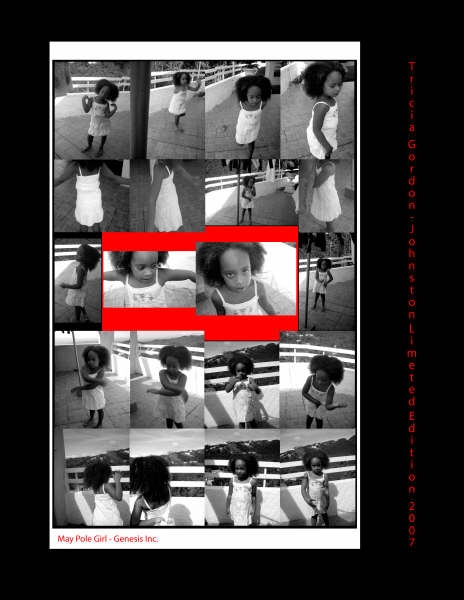
Tricia Gordon-Johnston: Balancing commercial and fine art practice


Tricia Gordon-Johnston is a practicing fine artist and recent graduate of Edna Manley College. She has exhibited in integral shows such as Curator's Eye II at The National Gallery in 2006 and SuperPlus Under 40 Artist of the Year 2006 at The Mutual Gallery. She currently does digital and photographic commercial design work alongside her artistic practice- not unlike many Jamaican artists. Her studio work however has been rooted in the conceptual tradition of feminist art and the tactile modernist work of various Latin American artists. ART:Jamaica has asked her to share some of her experience with balancing what has traditionally been thought to be conflicting forms of art.
Q. How do you balance art practice with your commercial work?
A. I think there is always a duality between Fine Art and Commercial work. Finding the balance, or the key must be in viewing both as art practice and contributing to our work each day, it is after all a way of life, as Petrona Morrison and Cecil Cooper used to state to us at The Edna Manley Collage of the Visual and Performing Arts.

Q.How did art college prepare you for real world survival?
A.College prepared me for the real world by both teaching me and reminding me that our vision of the world is what informs what we see from any perspective, if it is all beautiful, then it is all art, it's also what we make it.

Before I studied at Edna Manley Collage, I studied Business and Marketing. Now, as a practicing artist, I incorporate all three. The target market is also the audience, each possibly willing to purchase our version of our identity, as we project it on to a canvas.

I think our creative headspace is a Conceptual Space and not confined to a box, perhaps three boxes. I suppose the three boxes would be The National Gallery, the Mutual Gallery and of late I have also been thinking about The Cage Gallery. We each, I think bring something powerful, meaningful and excuisite to the table.

Also, when I sit at any table, I look and listen for live performance, that is what always transitions, for me, a circular table into a square of open-ended possibilities. I have also sat at many tables around the world and what makes me Nationalistic is both the way we fit in and stand out, internationally. Our Cultural 'flavour', if you will, is like an energy wire that connects us with consistent threads.

The fine arts are much like the fine art of everything. It may be an acquired taste, but if it ages like fine wine, then our identity is what reminds us that we have already done the healing an life is our Ackee and Saltfish, for the enjoy-ing.

Friday, January 26, 2007

Travelling Exhibitions and National Art:


At present there seems to be a shortage of travelling exhibitions in Jamaica. For reasons perhaps such as budget restrictions and shortage of the kind of space required before being allowed to host one of these exhibitions. This does something however: it keeps the gallery circuit and the art community closed. The National Gallery with its Biennial and Curator's Eye seeks to invite international curator's and artists to exhibit alongside local artists but the context seems to be innately about Jamaica and its cultural output, from the diaspora or not. Somehow leading to a kind of nationalism in art. It is true that this is one of the main roles of national art museums and galleries but what of privately run galleries?

On the other hand, if you think about the UK and its Young British Artists promotional strategies, the U.S. and its National Endowment for the Arts and Canada and its National Film Board, it seems that the national voice in art is a common policy or strategy. How does this sit with the idea of crossing boundaries and merging of cultures that is popular with theorists today. How can the Jamaican art community find a middle ground or is it a matter of government policy?

There is also the issue that I am even referring to art produced by persons culturally, geographically or historically associated with Jamaica as 'Jamaican' art. Is that valid to even search for the 'Jamaican' element in the equation?