INTRODUCING

Christina Leslie's Portraits

N.L.S., A New Local Space

Deborah Caroll Anzinger's artist run residency and exhibition space in Kingston

ON THE SCENE

Leasho Johnson's Provocative Re-interpretation in 'Canopy Guild'

Light Sensitive

Marlon James' black and whites

Annalee Davis: ON THE MAP

Caribbean Political Documentary

Showing posts with label kyoto. Show all posts

Monday, July 22, 2013

Less is More Design in Japan

Last Summer, while walking in a little off-road in Kyoto's city centre, I saw this window display.


Arrangement of clothes hanging in the window display

Arrangement of objects at the bottom of the window display


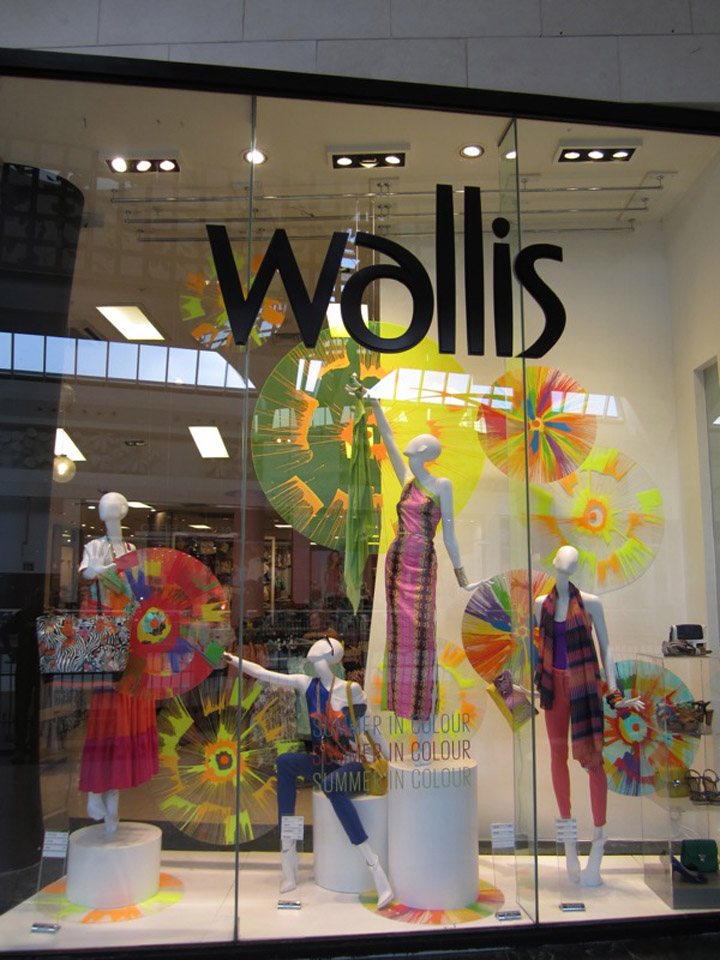
 I couldn't really believe it was a shop until checking that it did have a sign on the door and a few racks of clothes. In that street, which is next to a temple and a very quiet upscale part of the commercial district of quaint Kyoto, the store was just believable enough. It demonstrated several differences in approach to commercial design and aesthetic taste of the Caribbean. Our stores in the Caribbean are more direct and definitely colourful. They invite you to think about lifestyle and entertainment for example. Upscale UK and North American stores tend to have a very grand, opulent use of display space to trigger desire in customers. The display for UK store, Wallis for eg. shows the mannequins clothed in the wares of the franchise and other props to convey summery activities.
                                                               
Window displays similar to those seen in the Caribbean
Display Design of Diesel's flagship store


 In comparison, the display for "Urim" pictured below projects the zen-like, less is more, simple aesthetic Kyoto is famous for. It is not clear whether this store actually sells to the public or has private clientele or only serves as a space for aesthetic play. It is interesting to look at how arrangement and colour of natural elements and the goods in the store can be used as a another approach to design rather than large colorful, synthetic graphics. These are two approaches to bringing attention to the story of the brand.


Sign at the entrance of small store on Teramachi-dori, Kyoto
This is not to say that Kyoto doesn't have its fare share of large department stores like Louis Vuitton and Lacoste showing very eye-catching work. Vuitton has long been known for its collaboration with popular local artists such as Yayoi Kusama and Takeshi Murakami but this style of pared down hand-made visuals is more typical of smaller stores off the main roads.

 
What do you think is communicated by each approach? Do you think this minimal aesthetic has a place in Caribbean design?


Monday, January 30, 2012

Contemporary Art in Stores

The Kyoto BAL building's use of artist mirocomachiko's painting and
reproductions to create enticing tasteful window displays for
their New Year sale
The possibility of exposing art to the public is great if you utilize spaces that are less traditional. It is not uncommon to see reproductions and paintings and drawings of local artists used in banners, window displays and dedicated in-store displays in some of the trendy Japanese department stores. The image of the store benefits from the eye-catching, unique imagery of the artist and the artist benefits from the increase in appreciators and earning potential.

In arts cultures there is the stigma of watering down the seriousness of one's artists' persona by indulging in commercial activity to earn a living. This attitude perhaps became ingrained because the inability to live from your art could indicate that the artists work has not reached the level of development to attract committed collectors and dealers. In an age however when an ever increasing number of students are choosing to study media, frequently use Photoshop, engage in fan art and keep art schools thriving, it may call for reconsideration of attitudes toward fine artists pursuing commercial activity.

Window display using painting and graphics from mirocomachiko
On the ground, art dealers are charging larger percentages for access to gallery spaces and use of mailing lists while the public is reaffected by recession and tastes for collecting art decrease. It perhaps is time for artists to look to alternative avenues for diversifying their creativity. As an artist myself, I can also imagine getting my hands on window displays in stores in the city capital to create narratives and worlds which utilize the displays of the store.

What ways do you think artists can apply their talents to create diverse opportunities and reach new audiences?

Saturday, December 18, 2010

ghostly white

ARTSBAR@Rissei is an annual large exhibition of student work from art majors around the Osaka and Kyoto area of Japan. It was also an opportunity to have your works seen by future collectors and other art lovers.  It was good to see how much dedication was put into the show by the students, in fact the craftsmanship was quite high in many of the works but that is something I do notice here in Japan. There is great commitment to making something which even if it obeys its own aesthetic of simplicity or handicraft, is often technically lovely. I walked through the halls of the now abandoned Rissei Elementary school with its creaking board floors and long dark passages and thought I could see a pattern. Perhaps I was finding an aesthetic or cultural perspective or perhaps it was my outsiders reading of it. Below I have put some of the works that seemed to come together in its own theme. There were many others of note but for this purpose, being selective will illustrate more clearly.
Tomoko Tamura 田村 智子

Ashida Fuuma 芦田 風馬
Above, Hashimoto Tomonari 橋本 知成
Below, Kazusato Ooishi 大石 かずさと 


There was a aura about the works that was  repeated in the way the work was made and composed. A feeling of it being just barely there, fleeting, a thought realized for a moment and a feeling of a presence. In works such as the school desks made out of tracing paper, a school desk made out of barely perceptible wire, paper houses in old wash stands, portraits made out of melting ice, your thoughts could hover between wonder at the ease of destruction and wonder that the work had the strength to exist as is.

In other works there was a strong feeling of discomfort at being in the same space with it but also an inability to look away because of its strikingness. A gigantic and monstrous baby doll which you realise might just as easily come to life, when you think about it in the context of films like Tottoro or Spirited Away.


Artist Currently Unknown
The work indeed seemed delicate and precious but also acted as some kind of transport to a time or place or a memory. Of course uses of colour is also a main contributor to this. Colour is often kept quite limited by  utilizing only the raw materials and maybe slightly enhancing them. So the use of white and fragile or transforming materials seems to be what the future art stars in Japan lean towards.  I wonder if the art market is so fine tuned now that we can actually forecast trends for the next season like the fashion industry does?
Kimura Kento 木村 健人

Whether it is cultural aesthetic or trending there I think there may be a coming strand of contemporary art that goes beyond the coolness of minimalism. Work which is quiet and reflective but also uncanny in a way that you feel in the pit of you stomach. Work which bears an aura I refer to as being ghostly white.

Sai Jyungyoku 崔 じゅんぎょく

I am wondering what the trends or developing aesthetic in the various Caribbean islands are like now...

Sunday, December 5, 2010

Does it still hurt? Should it still hurt?


Walking through a trendy artsy student area one lazy Sunday in Kyoto, I entered this famous bookstore that is a famous landmark in the area. I found many interesting things, graphic zines, rare comics, out of print journals etc. Stacked to the gills with narrow passages in the way many bookstores are here, I came to the children's book section. Glanced down and saw Chibi Kuro Sanbo staring back at me.

The title in my limited scope of Japanese can be read as Little Black Sambo. I looked at Sambo for a while and he looked at me. Not sure of what my reaction should be. I stood there thinking that I am expected to have a reaction right or is that outdated in 2010? If I am not certain about my reaction, maybe I should have none but by having none am I agreeing to Chibi Kuro Sanbo; and thereby disregarding all that forefathers passed through so that I may be able to stand in Kyoto leisurely looking at this book? By now I could spy the bookseller looking at me either curiously or nervously. 

My question is, what would you do, is it meaningless and outdated to feel something about these stereotypes seeping back into daily life. If my objection to it is not going to interrupt the importance in this culture then how do I regard it? Are our reactions programmed expectations or do we have a valid point? Can it be explained away as part of the 'kawaii' cute culture in Japan and therefore harmless? ...and in a country where in most rooms you will often be the only person of colour can we expect a reaction to be understood or even heard?

I was thinking about these things all that time. I still had not much of a real emotion so took a photo instead. 

Figurines seen in restaurant windows in Teramachi shopping district, Kyoto

Monday, October 12, 2009

Shaving Bob Marley and giving you the finger.


Yuli Kande's (寒出 優里) works from Kyoto Current 

Living in Kingston, made me realise many things. One of which is that Bob Marley is one of the nation's most imaged persons in public spaces. Visiting Kyoto Current a couple weeks ago at Kyoto Municipal Museum of Art allowed me to see the image that is familiar but now represented differently. The Bob Marley portrait is just one of several large iconic portraits done by Yuli Kande. From an image seemingly familiar from American media such as a woman perhaps of Hispanic or African-American ethnicity painted on top of glittery bling giving us the finger to what can be read as a Japanese woman of homogenic identity  giving the well known Japanese snapshot fingers. Kande's work reminds you of the inside of the cadillac's of hip-hop culture. She seems to be using 'pimp my ride' aesthetics to etch out iconic cultural images. 

The show had so much to see and the young hopeful artists had an auction this weekend gone by. I am not sure how this works yet with the Japanese equivalents of Charles Saatchi but there was diversity to be seen. I saw what I expected and what I didn't. There were quiet zen-like landscapes, highly technical futuristic images, conceptual performance-derived work, tiny aesthetic statements and large explorations. I chose Kande's work for this post because I enjoyed it immediately and more importantly it confronted me. In the tranquility of Kyoto, anything that gives me the finger will get my attention.