INTRODUCING

Christina Leslie's Portraits

N.L.S., A New Local Space

Deborah Caroll Anzinger's artist run residency and exhibition space in Kingston

ON THE SCENE

Leasho Johnson's Provocative Re-interpretation in 'Canopy Guild'

Light Sensitive

Marlon James' black and whites

Annalee Davis: ON THE MAP

Caribbean Political Documentary

Showing posts with label Oneika Russell. Show all posts

Tuesday, May 6, 2014

INTRODUCING: Christina Leslie’s Portraits


Christina Leslie, The Video Hoe Vixen

Curated art site, Wondereur’s most recently selected artist to watch is Christina Leslie. Leslie creates using photography and African and Jamaican art collector/ curator Kenneth Montague describes her work as having ‘a deep poignant message around multiculturalism’ with ‘a terrible beauty’. Leslie has connections to Jamaica but lives and works in Canada. A selection from her series of recent double portraits can now be viewed. Each work uses two versions of the same person placed next to each other. The automatic impulse is to search for the relationship between the images or to compare them. In one of the double portraits, the close-up frontal photograph of a young black woman’s face is placed beside another photograph of the same woman in  blackface and a blond wig. The work’s title, The Video Hoe Vixen is what readily reveals how each image informs the other.

Christina Leslie, Calcutta Curry Boy
Her work offers two representations of the young woman and asks us to choose, to reflect, to think and associate these with certain realities and experiences. She asks friends and family to recall their own personal experiences with racial issues and assumptions about their identity. These stories apparently influence the images she decides to makes. Other works such as Geisha The China Doll, Calcutta Curry Boy and Bollywood Beauty present similar stereotypes which minorities in North America  may have experienced. With each of the double portraits, each individual goes through a transformation via masking of their faces and bodies with makeup and costumes which reflects the racist imagery concerning their ethnicity. “I might be opening up old wounds’ she says ‘but it’s not about throwing salt into them. It’s about opening up a conversation.”

Olivia McGilchrist, Red Dress 3

This conversation about racially problematic imagery is one which finds a connection with the various dialogues, voices and viewpoints in various contemporary art practices in the Caribbean. In 2009, Leslie showed work alongside other artists, including myself at the Rockstone & Bootheel exhibition at Real Art Ways in Connecticut. The show featured the work of artists connected to the Caribbean who were exploring various complex layers of Caribbean identity and experience. In particular there is a connection with the concerns of Renee Cox, Ebony Patterson and Marlon Griffith. In that exhibition the artists were involved in re-contextuazlising and thinking about identities via photography. Charles Landvreugd and Olivia McGilchrist’s work presented in other forums relates to this visual language of reclaiming and taking on stereotypes by using masking and cloaking of the body in reference to popular culture and thought.

The juxtaposition in Leslie’s work does play on the ideas of dual truths about individuals. How we see ourselves and how we are seen is a major point emerging from the work. The work holds two striking yet opposing points in that perhaps stereotypes do hold a version of a truth after all; and revealing that all images are constructed for desired effect. Leslie says about her work that “If one less person laughs at one less racist joke, I’m still doing my part in it.” These issues cannot be expected to be directly transplantable in the Caribbean. While we do speak about imagery and representation I don’t know that racism can be understood in the Caribbean in the same way as that which the artist attempts to counter.  Her dialogue is clearly aimed at the particular atmosphere in Canada and the U.S. but it finds kinship with the kind of work other artists are doing regionally.

See the full photo-journal story on Christina Leslie’s process and work at Wondereur


Tuesday, April 8, 2014

The Importance of Social Art Spaces

Students of the Time-based Media course at Edna Manley College participate in a studio visit at NLS
Over the past three weeks I have had the opportunity to engage in different ways with the new local space, NLS. The space has been active for about a year and is run by Deborah Caroll Anzinger and a small team of volunteers. With each visit a new opportunity presented itself to the various hats I wear as contemporary artist, art educator and arts writer among other things. On my first visit I had the chance to meet the newly arrived artist participating in the residency programme, Rodell Warner.  There was also the chance to present my work to visiting curators and catch-up with other artists.

Local artist, Leasho Johnson talks about branding, sexuality and identity in his current work
On the next visit there, just a week after, myself and other artists had the chance to have discussions about trends in art, the local art scene and look at each others work. The interesting part for me was that even though as local artists we were familiar with each others work, this more intimate, personal and social setting was a rarity. There was the realization that as artists we mostly ever saw each other's work when it was already smoothly projecting the aura of 'Art' after being mounted in national and international exhibitions. We never had public chances to see the developmental stages and phases or to listen to the background and ideas of the work. What occurred to me was that we mostly understood each others work as exhibition items or tools to win curatorial, institutional and public favour and notice. This second visit to NLS made me ask the question as to why local artists didn't meet to discuss and show their work to each other more often. If like our Tourism industry we only ever maintain links with the external purveyor of our 'goods' then an element of non-sustainability and risk of exploitation may creep in. 


Visiting artist, Rodell Warner, explains development and technical processes in his work to students
 That visit pushed me to make an appointment to have my current class of Time-based Media students from Edna Manley College make a studio visit with Warner. This past week the students took an approximately twenty minute walk over from Edna Manley College to NLS at Mountain View Avenue to listen to Warner's presentation. The proprietor, Anzinger began by introducing students to the micro-gallery/ studio and outdoor yard which form NLS. We heard about the yearly curatorial programme and open-call submissions from artists as well as the local and global initiatives being encouraged. The presentation once again fueled questions as to how the art scene and creative industry locally and regionally would be affected if more little hubs of small but active local spaces like NLS were to start-up. It is encouraging as Gallery 178 downtown has also recently had its first committee meeting so good things should be in store. There are undoubtedly many more local spaces and groups but the interconnectedness with each other and public awareness is thin and thus makes these spaces sometimes difficult to access. It can only create a healthier cultural environment if multiple independent spaces, encouraging social interaction and supporting creative practice were operating. The result might lead to the much needed diversity and counter-balance to often all-encompassing and sometimes exclusive state-initiatives for creative industries and The Arts.

Have you interacted with NLS or are involved with another independent initiative which facilitates local creative practices?


Sunday, December 9, 2012

Thanking Petrine

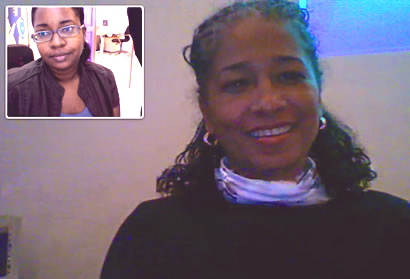
Skype screenshot from virtual Artists Talk with Petrine's Cornell Uni. course., 2006. Source Panmedia.com

Yesterday, I received the news that Petrine Archer-Straw had passed. This news dis take me by surprise. My connection with Petrine was mainly as a mentor for my artistic and academic work.  Throughout this period she showed great generosity in encouraging my artistic practice, academic pursuits and especially this blog. I first met Petrine when I had my final exams at Edna Manley College in Kingston. She was one of the examiners of my final year Painting Show. I remember her for insistence that I shouldn't settle for the easy pathways in my work.

Later on I had the chance to work with Petrine on her website Diaspora Dialogs by providing discussions and artist talks with her course at Cornell University. Throughout that time my interaction with Petrine as a young artist made me feel that there was something of importance in my work. When I last connected with her it was to ask her to be an external supervisor for my doctoral thesis in Japan. For administrative reasons this didn't work but she allowed me access to her writings to help guide the way for me. It therefore hits me with the weight of the news that one day after handing in said thesis that there will be no more chances to connect with Petrine.

I want to therefore thank you Petrine for encouraging and supporting me in my endeavors. I also want to thank you for contributing so much to the arts and understanding of culture.

Saturday, January 5, 2008

Materialising Slavery: Art, Artefact Memory and Identity


Images taken of the current exhibition at the Institute of Jamaica

The opening of the exhibition Materialising Slavery: Art, Artefact Memory and Identity was very well attended on Thursday, December 13, at 3 pm. Wayne Modest set the stage with the historical background of our Nation and the context within which each representing artist and ambassador leads. The exhibiting artists are David Boxer, Lawrence Graham-Brown, Christopher Irons, Khalfani Ra and Oneika Russell.

Though exhibited within fragmented spaces, the consistent threads that tied the exhibition together as a powerful forward movement shared by more established artists and the younger generation set examples for us all, as we celebrate the mark the 200th anniversary of the abolition of the Trans-Atlantic Trade of enslaved Africans to Jamaica.

The theory of existentialism, very simular to that of the chaos vs. symmetry theory were also clearly at work throughout the exhibition. Chattel slavery was clearly an injustice served against our Jamaican people in the context of our connection to Africa, the Black Diaspora, to Black people and to humanity in general. In this context, existentially, our ancestors have already bourn enough pain, suffering and anguish in our honour, this being a past purpose. If we refuse to view the world as being chaotic, there is always symmetry in the greater view of humanity. Every thing does in fact serve a purpose, one to learn from and add to our everyday rituals of "living good with people".

In locating ourselves in the present day and in an attempt to set a new paradigm, we need not necessarily re-live this pain and suffering. It is a much more suitable position to identify ourselves with the fact that those wounds have already been healed. We, the descendants, therefore are “Free” of these issues. The contemporary issues that our history continues to prove relevant are issues of identity, race, gender and the body.

It all came together in the new galleries of the Institute of Jamaica, 95-97 Water Lane (entrance at #10 East Street). This exhibition is part of the collaborative project Materialising Slavery: Art, Artefact Memory and Identity being put on by the Museums of History and Ethnography and the National Gallery of Jamaica.

I cannot possibly reflect to you what experiencing this installation of fine artists is like, please visit the site in person. All were and continue to be invited to play a significant part in this exhibition.

The exhibition closes in March 2008.

contributed by Tricia Gordon-Johnston