
INTRODUCING

Christina Leslie's Portraits

N.L.S., A New Local Space

Deborah Caroll Anzinger's artist run residency and exhibition space in Kingston

ON THE SCENE

Leasho Johnson's Provocative Re-interpretation in 'Canopy Guild'

Light Sensitive

Marlon James' black and whites

Annalee Davis: ON THE MAP

Caribbean Political Documentary

Saturday, September 19, 2009

Under the Sea


Journeyman Pictures has released a film showing the under water sculptures of UK artist Jason de Caires Taylor. Haunting and surprising but it mostly puts me in mind of what Laura Facey's sculptures like 'Redemption Song' might look like if Kingston became and Atlantis. The sculptures are placed offshore Grenada and are meant for people to view and interact with. How do you think we are meant to relate to underwater sculpture? See the video preview on Youtube

Sunday, August 30, 2009

The Fashion Industry – Ambassadors of the Jamaica Brand?


Recently, I came across a series of fascinating articles on the Australian Fashion industry and how it was being positioned to service the Australia brand internationally. Indeed Austrade’s (Australian Trade Commission) National Manager, Rob Sutton commented that:

‘The Australian Fashion industry isn’t just about fabrics, frocks and fanfare, but one of the key cultural ambassador industries. Fashion is one of Australia’s key creative and design industries and we know that there are over 2000 active fashion exporters delivering their products and services in overseas markets”.

It occurred to me that Jamaica might not be fully exploiting its own successes in the fashion industry to market Jamaica. When I say successes I mean the country’s international reputation for producing international top models whom have graced the cover of top fashion magazines (Vogue, Essence etc).

Jamaica – A Place for Fashion? Lessons from Australia
Jamaica has also had enormous success premised on its past victories at international fashion industry competitions such as Miss World and Miss Universe pageants. These arenas have not only exhibited the beauty of our women, but displayed Jamaica’s top class designers and the quality of their productions.

Australia has no doubt recognised that it has an international reputation for producing some of the emerging stars in the fashion world. The country is therefore committed, Sutton says, to exporting this vision with the goal of reflecting their creative environment; modern fresh ideas and quality products.

As part of Brand Australia, Sutton says, they look at promoting the image of the nation through varying strategies, with fashion being an attractive component of that vision. For them, it holds key international mainstream media impacts, artistic component and celebrity story reach.

This is undoubtedly true as I notice that top celebrities such as Eva Mendez, among others, have been flying into Australia to sample the design collections of many Australian designs – from the mundane items such as bracelets and bangles to top market pieces such as clothes, bags and shoes! Obviously, Australian celebrities such as pop singer, Kylie Minogue and actress Nicole kidman would have helped to establish the Australian brand by buying and wearing Australian desisgners.
Sutton argues that:
“It really helps to further Australia’s message through the creative industry. We are able to project diversity from pour relaxed beach culture – with our leading surf wear/swimwear brands to our vibrant cosmopolitan city lifestyles – with our urban street wear companies and cutting edge high fashion designers”.

Reggae Fashion
No doubt, the Bob Marley clan have cornered a part of the reggae wear market and have had celebs such as Gwen Stefani sporting the signature reggae colours. Other artistes such as Sean Paul, Sean Kingston and Shaggy have been instrumental in enabling the Jamaica design brand overseas. Cooyah designs and others have emerged as niche marketers of a line of Jamaica clothing. It would have been nice to see them in Berlin expanding the reach of Jamaica and Jamaican designs on the world stage.


Jamaican Street Wear – Untapped Potential
I give credit to the emergence of a wide variety of Jamaican urban ‘street clothing’ by creative young designers. The ‘Portmore Collection’ and the Kingston Collection have the potential to take off. Some entertainers such as General Degree have been attempting to tap into the T-shirt market. This is also a good thing as the worldwide obsession with reggae and Jamaica and things Jamaican mean that the space is wide open for further in roads to be made in this arena.

Australia’s creative industry particularly in fashion was showcased at the Rosemount fashion week in 2008. It featured Australian brands such as Jayson Brunsdon, High Tea, Mrs Woo, Madame Marie Rachel Bending which captured international buyer interest from countries as diverse as the USA, Canada, Italy, Spain, Indonesia, Malaysia, Thailand, Japan, Hong Kong, China and New Zealand.

Government Support
Like other cultural industries, the fashion industry may require government support. Sutton chalks up Australia’s success to the “result of the ongoing work that Austrade does in-market throughout the year to raise the profile and image of Australian brands. Actively supporting Australian brands and helping Australian exporters overseas. We work closely with retail buyers and agents to highlight the unique style of the Australian fashion industry.
Sutton considers as successes Austyle London and Dubai, Thailand’s Fashionably Australia and the 200 Ford Supermodel of the World event, which featured some of Australia’s top designers to more than 1000 of the worlds influential fashion leaders and international media.
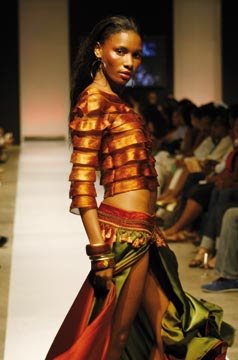

It certainly would be interesting to the Caribbean Fashion Week – which I have enjoyed immensely every time it’s on – receive the kinds of international exposure and traction apparent in Australia. And Jamaican/Caribbean designers tap into the international circuit.

The success of the Australian business model is apparent – strategic thinking and positioning. In short, it’s no accident or chance encounter but deliberately planned and executed.

Educating And Training in Fashion
Sutton’s commentary is telling here: “We (Australia) have also worked hard to host pre-fashion week seminars with over 100 participants to bring interested new fashion exporters up to speed on managing international sales growth and the expectations of our international guests”.

Education and training – what would we do without it. It would appear that Jamaica has left fashion to the ‘unskilled’- those who can’t find a job and therefore should get [‘sewing’] skills. The perception of the industry must change and fashion seen as not just a alternative vocation for less formally educated but a real industry that can produce stars of design – clothes, shoes, bags etc.

The fact that Australia created their own ‘Project Runway Australia” reality show to much popularity, and established popular design schools for those wanting a career in the field - only serves to crank up interest in the fashion and design industry and ensure its endurance.

Jamaica is well-positioned to tap into the fashion market. We just need to seize the opportunity.

For more information on Australia’s creative industries, see www.austrade.gov.au

Contributed by Dr. Hume Johnson
Dr. Hume Johnson is a communications consultant, co-founder of The Communication Workshop; http://thecommunicationexperts.blogspot.com
Also see, Talking Politics at http://humejohnson.wordpress.com
Images sourced online from Caribbean Beat blog, fashionoverstyle_photos on photobucket.com, dryhyphenplympics.blospot.com

Wednesday, June 10, 2009

POSTMUSEUM & The Downtown Story


In June 2007, I received a strange email. It said I had received the Commonwealth Arts & Crafts Award. I fell into deep disbelief. I still don’t believe it even though I can however recall the frustration I was experiencing in my artistic career when I applied, the months of tiring planning, the newness and out of body emotions of being in my host country, the many lessons learned about acting as administrator as well as artist simultaneously and the satisfaction with being able to work independently in my own studio for the first time in a few years. When I applied for the Award, I wanted to revisit the UK, being that my relationship with Britain was the basis of my work. I was however asked to find a location in Africa. I chose South Africa, specifically Cape Town. This however was not fated and going through a series of events and restrictions, I finally settled on Singapore. I had then two views of Singapore, as I would come to find out was similar to the view Singaporeans had of Jamaica. There was the romantic idea of Singapore and its colonial era memory and little bits of circulating information of a modern more edgy, thriving and highly restrictive Singapore. This I found to be true and untrue in parts, I also had a classmate who was one of the most well informed artists I had met in my small experience. With all of this in my head and the exciting but frightening prospect of doing my first serious artists residency, which had received some small publicity, I booked my ticket and took the 25 hour journey, ironically via London, to Postmuseum, Singapore.


I arrived at an artists space on a bustling Sunday night in Little India. The first persons I met while still groggy with jet-lag were a group of international and local artists sitting at a table at a social art project manifested as a vegetarian café. Many of those artists I met on my first night were to become my support during my 4 month stay. I asked at one point, why it was called Postmuseum. Singapore is a city-state with around 5 or more well-developed museums, 3-4 large arts education institutions. This I understood to be a country with an overwhelming concern with the organization of its art and culture, though granted I would welcome this sometimes in Jamaica. Postmuseum, I slowly realised was a space away from institutional enterprise. It was social in concerns, communities and the notion of locality was central. The room I stayed in, the loft, was an old brothel and at night while working in studio, I could see and evidence of being situated in the red-light district. This was definitely experiencing the local community and being intermingled with their stories. Though, I was in an environment different to ordinary experiences, I felt more connected to my location and was able to more easily transition this into my work. I mention these things because of the ideas it provided. There was a sense that artists were not willing to abandon areas of a city, that though now a bit seedy were still historically and culturally rich, because of fear or stigma. They were not only willing but enthusiastic to build their lives and make their work in the heart of it.


In considering the Postmuseum project, initiated by the P-10 collective, including Jennifer Teo and Woon Tien Wei, I remember my own attempts at trying to secure an equivalent space in Jamaica. Before I ever had thoughts of applying to the Commonwealth, I was in desperate need of my own studio space. Along with other local artists under the main co-ordination of established artist, Stanford Watson we tried to secure an unused and completely abandoned segment of the Bellevue Hospital. We waited months ending in final refusal. On my own I tried to rent one of the continually empty shop spaces at the Kingston Mall, which seemed to get most of its tiny stream of traffic from persons needing a short-cut rather than actual customers. I was quoted a figure so high that I doubt that an ordinary business person may have been able to make the rent. I tried to rent an office space on one of the several abandoned floors of the Ministry of Health Building. That at the time I was told was only available if the entire floor were being rented. There are several other instances, not only by myself but other artists. I do wonder at this point in remembering Little India, Singapore, Brooklyn, USA and Deptford and Brockley, UK, whether there may ever be a Downtown Kingston, Jamaica story.


Why do we seem to not be able to recognize the potential of the creative individual to regenerate and develop. Bringing new life and purpose to depressed areas through cultural activity is a formula used by many progressive state bodies. Should there not be some kind of recognition through our policy that culture is the new tourism, economy, politics etc. and that any aid to assist in development should not be grudgingly given or frustrated or turned away but enthusiastically aided. Given the mass of unused buildings which in Kingston which are almost untouchable as we seek to find absentee landlords(In some cases the landlord may be found but for unknown reasons seemingly prefers the buildings left in their abandoned state. Of course there are projects that have begun, noteably The Rock Tower, Multi-care’s Ice Factory and Gallery 178 but many are barely surviving and in need of support. Support from other artists, institutions, the state, collectors, private sector and the list goes on. Can we not make a concerted effort to have a new cultural and subsequently economic Renaissance? Could we have a thriving developing hub of activity on the arts front where artists are aided and assisted readily and not frustrated into seeking opportunity elsewhere. Can we have our Downtown story?

Friday, May 15, 2009

Glee Club and Folk Music

Got this video sent to me in a forwarded email. I think in case you didn't get to see it, here is the opportunity. To view a an interesting moment of cultural transference/ borrowing/ appreciation etc. What do you think about this rendition, the interpretation and what it means for Jamaican music and culture. How do you feel about this.

Tuesday, March 31, 2009

Searching for Jollywood

I am among many persons concerned about or at least curious about the lack of a thriving film industry. We want so much to have the tangible evidence of the creativity and richness of our storytelling tradition in that most glamorous and cool of cultural industries. We are proud of the handful of critically acclaimed films but we still wonder what can be done to jumpstart the way. Many in the authority roles in the country have tried form starting film festivals, holding forums and conferences, sponsoring proportionately big budget productions, funding training camps. inviting the many film industry professionals from the US and UK, who are often expected to breathe life into our feeble infant of an industry by waving a magical stick. I thought maybe Jamaica's film industry cannot start as an industry, maybe we shouldn't yearn for a type of Jamaican version of Hollywood. Our Jollywood maybe found perhaps in the cheap tools and technologies that many have around us and take for granted. Maybe we shouldn't look to others for that million dollar budget, maybe we could start in our own back yard, in small rooms, in our spare time, just go for it. Be it bad or rude or crude it perhaps should just start from anyone interested. Our Jollywood will most certainly start from the underbelly, the unschooled or schooled but definitely the passionate. Who says that we need to know and use a particular way, lets build our own way or work on using the mainstream way in our own way. I recently watched 'Be Kind Rewind' and felt how great that would be for us to inspire any kind of attempt at social change, recording personal histories,engaging our culture and imagination through something like grass roots films, animations etc. If we don't know how to or what to do first or even have already tried I invite you to use this blog and our Google group forum as the place to network and share ideas and air what you have, call for participants etc. Ask a question and hopefully you can find an answer.
One group of students from Northern Caribbean University students have already released a few films online and have been building a following on YouTube. I present The 'Revenge of Hurricane Tongue'

Thursday, March 26, 2009

National Biennial 2008: Ebony G. Patterson

http://www.blogger.com/img/blank.gif
Watch Petrine Archer-Straw's interview with Ebony Patterson

Interview by Nikki-Ann Chambers

What inspired you to do this piece?
The kind of hypocrisy that is evident in our Jamaican culture. We “bun out” “batty man” which is seen as a kind of feminist thing yet the real men and the “ganstas” dress better than women, wear questionable women clothes, bleach [which used to be a woman ting] and pretty up more than most women today. However the work is not about homosexuality but an exploration of a shift in masculity , and the contradictions of what was once the anti-mocho. The feminity is now reshaping the masculine

How do you see this room and what is the story of this room?

I Use and see the room as a faux feminine, really questioning what masculinity is, our ideas about beauty and the grotesque and how that all ties in with stereotypes and our perceptions, a culture and a people.

What relation do the tampons have to the general piece?

I refer to them as the “pussy bulletz” and I wanted to use something that was obviously feminine to juxtapose with the homosexual serotypes that I created with these photographic images. What is really interesting is the shape of the tampons and how they resemble and echo the shape of a bullet.

What relation do the men have within the piece?
I use young men within a particular age group as they represent a demographic involved in the practice. Unlike persons in the the 1990’s that did this for social mobility , these young men are not bleaching and going up-town in suites to look for jobs. They are on the corners and getting involved inillegitimate activities but at the same time it seems that a faux feminine that is beginning to immerge from their appearance. This juxtapose with objects that are obliviously feminine and liking that to “gansta culture,” an aspiration and gratification of the “gansta”.

Does the colour of the wall plays a divider or a link between what is masculine and what is feminine?
Red can be seen as a neutral colour of the sexes. I chose it and if u realize is not “red red” but more of a pinkish red. I did this to play on the whole concept of how the men are bordering the line between masculinity and femininity.

-The original post has been edited to accommodate requests by the artist, Ebony G. Patterson

Tuesday, March 3, 2009

National Biennial 2008: O’Dwayne Wilson


Interview by Peta-Ann Smith, Jan. 26, 2009

PS: Based on your displayed work, the figures appear to be dressed as high-ranking Catholic clergymen. Did the fairly recent child abuse scandal that rocked the Catholic Church inspire this particular piece?
OW: Yes the recent events have influenced me to do works examining the role of the clergy and religion on a whole. But then what really did it for me was the film ‘Deliver us from Evil’ which was a biopic on a clergy man who molested kids at whichever church he went and the cover ups surrounding it.

PS: Did the subject matter of the work influence your choice of media? If so, in what manner?
b) If the subject matter bore no influence on choice of media, what inspired you to select these particular materials rather that use traditional canvas?
OW: Yes it did to an extent, the cloth, wood and the nails where all symbolic of the Catholicism. However the wood was mostly found due to constraints in the project and to off- set cost of the work. The wood was lying everywhere especially since the school was under going minor constructions. So I made use of what my environment could afford me. The cloth was also was interesting experiment in it self.

PW: Given the controversial nature of the work, especially when one considers the events of the past five years, do you think you'll revisit this subject in future pieces?
OW: Yes I would but it would be used as sort of linkages between ideas. Besides there are so many dimensions to the topic and a historical context which I feel could be explored more in depth. But I wouldn’t want to replicate the same works again in terms of the structure and forms that they took. I believe that the works would have worked better as an installation.

PW: Have you considered other themes and/or subjects that you would like to explore in your future pieces? If so, would you be willing to give us an idea of what you'd like to examine next?
OW: Hard to say ... the current financial situation of the world is always a stimulus because it affects every one on so many levels.
What I am watching right now is the conflict in Gaza and how that plays out. It has more effect on me right now. The battle happening there is a historic and an old one and has not been resolved for thousands of years. But its hard to say right now. But I am interested in doing a piece focusing on issues closer to home.

PW: Apart from different subjects, are there any media that you'd like to utilise in the future? If so, which media do you think will be the most challenging and possibly the most rewarding?
OW: I’ve always wanted to do digital media because of ability to be visually agile. It can enable me to explore a range of issues and techniques and maybe even venture into filmmaking.

Alphonso Dunn Emerges


Some time ago, I heard from Alphonso Dunn. He had recently left the New York Academy of Art and just beginning to build his body of work. He had left Jamaica while still a teenager and was interested in his connection to Jamaica, which was evident through his work. I began plans to feature this artist next on this blogspot. Suddenly, Alphonso disappeared from our radar and time passed. Alphonso has recently resurfaced with exciting news of new directions, group shows in New York and studio life. Now is the time for ART:Jamaica to introduce you to Alphonso Dunn.

So I would like to just hear about the experience of leaving Jamaica for the U.S.,.
AD: I moved to the states with my mother and sisters when I was 17. I had almost finished high school in Jamaica.

Were you interested in art before that?
AD: Although throughout my earlier school years I concentrated most of efforts in the sciences—aspiring to be a doctor—I was always active in art, whether doodling or copying tirelessly from art instruction books , comics and cartoons. My earliest memories in art are from second grade, drawing comic book characters and creating superheroes. But it was while attending St. Jago High School that I started to really hone my drawing skills, and took art much more seriously. I entered several art and poster competitions and often placed very well. It was there too that I had my first apprenticeship-like experience, via my two art teachers; Mr. Barrett and Mr. Collins. Mr. Barrett was more the abtract expressionist and Mr. Collins the realist, but both more or less figurative artists. I copied inexhaustibly from Mr. Collins' drawings and spent countless hours discussing art theory and ideas with Mr. Barrett. They were very nurturing and complemented each other very well, as opposite in temperament as they were. Looking back, that was an integral component of my artistic development. Even now, more than 13 years later I still make it a priority to visit them whenever I'm in Jamaica.

What was the experience of attending New York Academy of Art?
AD: After moving to the states, I did a year of high school before going to study Chemistry at William Paterson University, in NJ. I was still bent on going to medical school but was able to squeeze in one figure drawing course. While in school I amassed an impressive collection of figure drawing instruction books, which I practiced from voraciously. I was virtually self-taught between high school and grad school, which inadvertently provided me with a portfolio of work to submit for grad school admission.
Upon graduating college I decided to pursue a formal art education. It took much courage to do this because I had to accept I would disappoint the expectations of people that were very important to me. But in some weird way I knew they understood.
My two years at the New York Academy of Art were two of the most wonderful years of my life. It was my first time indulging in such a rich and nurturing space of people, whose sole aspiration was set on making figurative fine art. The Academy, as a graduate school, is unique for placing the study and representation of the figure and its conceptual and metaphorical aspects at the center of its curriculum. I was in heaven.

How did you relate to studying the European-derived academic approach to art.
AD: Interestingly, I was already familiar with much of the European masters and the academic approach to representation through my many books on art. It was exciting to be around people who felt just as passionate about the representation of the figure, both instructors and students alike. Regrettably, however, I had to seek outside the academy for any information or instruction on the art of people who were non-Caucasian. This was not a new experience, and was not unexpected. My priority was to develop my skills at representing the figure as best as I could.


How does your Caribbean orientation affect the way you make work (subject matter, concepts, process etc.)?
AD: I'm not sure there how easy it is to articulate the nature and degree of influence of my Caribbean heritage on the ideas behind my work, no more than I can acknowledge the plight of the African Diaspora virtually everywhere...
I think of all the aspects of my work, my Caribbean background speaks most strongly through my passion for draftsmanship and the figure. Growing up in Jamaica, I had virtually no access to any other medium but pencil and ink, and occasionally poster paint. I only read of oil and acrylic, and sculpture was as remote as an art supply store. I focused my energies on what tools I had: cheap HB and colored pencils, and extra-fine point writing pens. Thus, started my life-long love affair with line.
Even today I doubt most children in Jamaica have access to any more medium than I did back then. But with learning several years later the importance and centrality of drawing to other arts, I have no regret that drawing was my involuntary choice.

Tell me about a recent body of work and your future plans for your artistic growth and your search to link with the Jamaican arts community.
AD: My recent work comes from years of trying to find an effective way to translate my ideas though a visual language that best complements and challenges my way of creating. I love realism and I love abstraction, but I resent realism and abstraction for their own sake. My work, ultimately, is driven from a place unique to me as a child of the African Diaspora and as a member of a very troubled and complex human race.
I want to make art that provoke questions and addresses concerns about perception and truth, the human imagination and power, and their effect on how we construct meaning and drive our relations with the world, others and ourselves.
In my drawings there is an unsettling tension created by the juxtapositions between text and image, childlike drawing and naturalistic representation, that challenges the viewer to intermittently suspend and reframe “adult” perceptions and judgments and become engrossed in a dynamic cross-referencing in order to construct a comprehensive meaning of the work. Neither language nor image is all-inclusive of meaning or truth, but through the seductive engagement of the imagination, perception is framed and realities made of figments. This visual experience calls attention to a reevaluation of our own habitual ways of seeing, deferring our seemingly automatic inner-processes of constructing meaning and directing action; the experience of finding what I refer to as our perception’s locus of control.

I hope to interact with other artists of the Jamaica and Caribbean and engage in meaningful exchange on art, ideas, and finding and defining our space and clarifying questions. I believe all true artists are intellectuals, yearning for discussion.

You may contact the featured artist and see more of his work at www.alphonsodunn.com

Saturday, February 21, 2009

LECTURE @ National Gallery: Reframing Slavery


Dr. Krista Thompson to Present 2009 Edna Manley Memorial Lecture on Thursday, March 5 at the National Gallery of Jamaica

The Edna Manley Foundation, in association with the Edna Manley College and the National Gallery of Jamaica, is pleased to present its 2009 Edna Manley Memorial Lecture, Reframing Slavery: Photography, History, and Re(Memory) by Krista Thompson. The lecture will take place at the National Gallery of Jamaica, Kingston Mall, on Thursday, March 5, 2009, starting at 2:30 pm. A reception will follow at the end of the lecture.

The Edna Manley Foundation was established shortly after Edna Manley's death in 1987, as a foundation dedicated to her artistic legacy, in terms of her own work and her broader role in Jamaican art. The Foundation is also dedicated to the broader development of art in Jamaica and to stimulating intellectual discourse on the subject. Its activities include, among others, the organization of an annual Edna Manley Memorial Lecture, which is featured during Edna Manley Week, the Edna Manley College's annual founders' week. While the inaugural lecture focused on aspects of Edna Manley's life and work, this year's lecture will cast a broader look at Caribbean culture and history.

Krista Thompson's Reframing Slavery lecture examines how photographs from the late nineteenth century inform visual memory in Jamaica and in the Anglophone Caribbean more generally. It explores how, despite photography's invention as slavery was being abolished in the English speaking territories, historians often use photographs from the post-slavery period to represent slavery. While this occludes aspects of the history of slavery from view, it also brings into focus African Diasporic ways of remembering. Indeed, the transposition of slavery and the late nineteenth century in some historical accounts seems to aptly capture what Toni Morrison characterizes as "re-memory" among enslaved Africans and their descendants, the ruptures in space and time, the ever-presentness of the past, that are intrinsic to the memory of slavery and to the formation of the African Diaspora more generally.

Krista A. Thompson is Assistant Professor of Art History at Northwestern University and the author of An Eye for the Tropics (2006), an examination of the colonial imaging of the Anglophone Caribbean in photographs and its effects on landscape, history, race, governmentality, and contemporary art. She holds a Ph.D. in Art History and Cultural Studies from Emory University. A Getty Foundation postdoctoral fellow (2008-2009), she is currently working on a book titled The Visual Economy of Light in African Diasporic Practice on the intersections among black vernacular forms of photography, performance, and contemporary art in the Caribbean and the United States. Her writings have appeared in American Art, The Drama Review, and Small Axe.

The Edna Manley Memorial Lecture is free and open to the public. For more information, contact Veerle Poupeye, at 929-2350-2 @ extension 2117, mobile 579-8282 or veerle.poupeye@emc.edu.jm.

-contributed by Veerle Poupeye

Monday, November 3, 2008

LOOKING AHEAD: There are times when I look back....


YOUNG, GIFTED & BLACK

A newish old space holds a second launch with an exhibition of contemporary art. The curator and director of the space Rozi Chung sees the show as launching the new Jamaican artist. At the same time the show goes back to a time when being rude, loud, raw, smart, clever, informed, playful was what art was about. A time before commercial gallery art shows and artists prizes and slickness. A new, old moment. The show opens on Saturday November 8, 2008 @ 3pm. There will be a mix and expansion of what we call art. Graphic artists, screenwriters, painters, musicians, pop dancers will be part of the opening event. The space may be found at 174 Harbour Street, with its entrance on West Street. Coincidentally it is also a stone's throw away from The National Gallery of Jamaica. We invite you to attend and post comments or images on the experience.

'Studio 174- Press Release

Located at 174 Harbour Street Kingston (Down Town), Studio 174 –home to a collection of young Artists recently graduate from the Edna Manley College of the Visual and Performing Arts, Presents its second opening, titled “ Young Gifted and Black”, with guest speaker Rose Bennett, Attorney at law Slated to commerce at 3.00pm on the 8th of November 2008, the exhibit will represent the dynamic and creative expressions of an empowered group of young Jamaican talent destined to leave the imprints on the Jamaican culture and people. This is defined by their deliberated move from being based in an uptown Artistic Avenue to a venue more directly positioned in Downtown Kingston, the catalyst of new artist dynamism.

The gesture is aimed at creating a hub in which Art influences and is influence by community development, cultural exchange, heritage and tourism embodying an idea more than social intervention bringing a multifaceted approach to building a foundation. It is the hope that with this youthful vision others will be of a mind to initiate similar entrepreneurial feats, fostering new endeavours, found on a revolutionary artistic direction which challenges the stereotypical misconceptions and directions of Art.'

Thursday, August 21, 2008

NIGGAH DEH WINNAH: Lawrence Graham Brown


Still on the highs of the wins made in Beijing by the Jamaican team, it seems appropriate to speak about 'Niggah Deh Winnah'. Lawrence Graham-Brown, A Jamaican artist based in the United States who has exhibited regularly on the Jamaican art scene,tells us about his work.

I first saw Graham-Brown's work in the 2005 Biennial at The National Gallery. I was convinced it was the work of a newly emerging older artist, given the 'intuitive' use of materials and the links to the work of contemporary intuitives like David Marchand.The scribbling of the text 'Niggah Deh Winnah' on work in later exhibitions however began to put this to rest. This was an artist who had sly covert and deeply political concern. This I must admit revealed my prejudice of the label 'intuitive'. I looked at the method of craftsmanship, the colour scheme, manner of representation and immediately felt that this must be the work of one of the artists we often label 'Intuitives'. The label often seems associated with a kind of mysticism and romanticism about their process and 'inspiration'.

This is how I placed Graham-Brown neatly in a box as I tried to absorb the huge phallus attached to a small ethnicized figurine resembling a kind of centaur. The phrase 'Niggah Deh Winnah' kept appearing on his work mounted in various group exhibitions held locally in the last two or so years. Appearing in shows such as 'Materialising Slavery' an installation-focused exhibit at the Institute of Jamaica last September and the JCDC Fine Arts Festival in 2007. Graham-Brown's work has since helped me travel further into the intellectual depth of our Intuitive artists such as Ras Dizzy, Everald Brown and Evadne Cruikshank. The artist now gives us some insight into the series.

'Wrestling with struggles within the confines and legacies
of Black self-hatred, gay self-hatred, Black-ness,
Jamaican-ness, African-ness, sexuality, class and religion.
With influences from the Rastafarian movement, Hon. Marcus
Garvey, history, the present and the future for my artistic
commentary and protest.

There are three themes that my work circum-navigates:

A.
The series “The legacy of degradation. The Black man
relegated to a life of servitude and the beast of
burden.” This is the genesis of my work from my Black
memorabilia collection. A re-discovery of Black hatred and
a quest for identity has driven me to investigating
architectural components of Black servitude, free labor and
its legacies via modern industrialization example: the
prison system, factories, hospitals, and domestics in the
form of printed historical documents from the
mid-nineteenth century to the present. displayed in a
collage mixed media.

B.
The series The Nigger the Winner, “Niggah deh Winnah”
Pan-African play on words, is a form of aspiration and
protest for my race. Since the images that I use in my art
are so degrading of the Negro. "Negro in impropia
persona"
Writing the words in a broken Jamaican dialect [patois]
is a form of passive protest of the colonizers language.

C. The series “Who is most masculine?” interrogates and
comments on masculine constructs, identities and legacies by
the display of power and control within the domestics,
tourist trade, industrialization, gender policing within
the Afro-Caribbean culture and the gay balls in the United
States via dvd.'
- Lawrence Graham-Brown
