INTRODUCING

Christina Leslie's Portraits

N.L.S., A New Local Space

Deborah Caroll Anzinger's artist run residency and exhibition space in Kingston

ON THE SCENE

Leasho Johnson's Provocative Re-interpretation in 'Canopy Guild'

Light Sensitive

Marlon James' black and whites

Annalee Davis: ON THE MAP

Caribbean Political Documentary

Friday, February 15, 2008

State of the Arts: A Letter from Christopher Gonzalez

An example of Christopher Gonzalez's work from www.harmonyhall.com

When ART:Jamaica sent out its first e-newsletter in November 2007,we received a an email from Christopher Gonzalez, famed Jamaican artist, speaking about many timely issues within Jamaican contemporary art. I then assured Mr. Gonzalez that this blog was founded to promote the under-reperesented, whoever that may be. We do however focus on contemporary art as we want to help develop a culture once again of the same passion and openness that existed in the early days of the Jamaica School of Art in the Seventies. Mr. Gonzalez raises many issues which link to the history and nature of the way art has developed in this country. We welcome dialogue and invite you to engage in a discussion. His letter follows below.These views do not necessarily reflect the views of ART:Jamaica


Hello,
What is contemporary Jamaican Art ? Is it a take off from the American Art contemporary , where any freaky cocaine Art is accepted ? How in the world can we be influenced by this " Bastard culture ", " This Commercial Harlot" Can someone tell me this ?
In what way can " timeshow design" assist the development of Art in Jamaica ? Will they lobby with the Government to establish a Policy to protect the Arts and the Artists, since they do not listen to us for years now? There is now an upsurge in the interest of the Arts and I wonder if it is really genuine and sincere, or they have awaken to the potencialy mega-earning power and want to rob and exploit the Artists again as they have done over the years.

The Great King Pin of NCB instead of supporting the Jamaican Artists , he supported the" Large" Kingston Art collector.......... making that collector more wealthy . I am one of the Artists he has exploited . Twenty years ago I wrote a letter expressing my disgust in his attitude to artists. He has not bought a piece of thumbnail sketch from me since.

The Artists are the ones needing support, not the wealthy Patrons ! His brother keeps sponsoring Artists under 40 years old . This has always been the way here in Jamaica, delete the older Artists and promote the young ! This is dreadfuly wrong ! I remember as a young Artist , they droped Alvin Marriot and gave me a public commission because they could exploit me in terms of price. The first real public commission I got was the portrait of William Gordon, they paid me $100.00 Jamaican. They could not pay Marriot that figure !

I saw the show , "Young Generation" I got a bit confused , since I felt I was somewhere in New York or California. The Art reflect absolutely no Caribbean flavour or feelings ! Someone in the Gallery, on the afternoon I visited , said , " Art is Universal" Yes ! I agree , but it should carry Identity ! Please do not misunderstand, I am all for experimentation and exploration in contemporary imagery. More than twenty years ago , I taught a class in Three dimensional
design at The Edna Manley college( at that time, The Jamaica school of arts ) it was all about experimentation , but not to the cost of identity ! Maybe, this is the way of the 21st century , delete all aspects of Nationality and Identity and become a non entity in the so called "Global Village".........................

We really need to look into this trend of ignoring the older Artists for the young, remember , the older Artists paved the way for these younger ones and they have suffered much exploitation and disrespect in the past and still experiencing . Why the "King" don't sponsor at the end of the year, a show for Artists over 50 years old and put up 1.5ml. as first prize ? Are we like old books that you put in the store room and take them out when you want to give them a token award ? The same thing will happen when these present young Artists reach over 40 or 50. This is wrong , wrong , wrong !

Another negative this does is to create division betwwen the young and older Artists , giving the younger ones the illusion that they are more progressive and the older ones nonprogressive, stagnant, not contemporary........The young Artists have never invited me to their show( one or two may do it) The Mutual life Gallery clearly told me , the Gallery do not invite Artists, it is left entirely up to the exhibiting Artist or Artists. Is this healthy ?
Best regards !


Sincerely ,
Christopher Gonzalez

Do you agree or disagree with this letter?; What has your experience been as an artist, collector or agent/dealer/curator/art lover etc.? What steps can we take to ensure inclusion for artists and their rights. Is it a collector-driven system and if so, how has it shaped the arts in Jamaica and what are its advantages and disadvantages.

Thursday, January 10, 2008

SYMBIOSIS: Marlon Griffith


Marlon Griffith, a young Trinidadian artist, had his first solo show in Jamaica towards the end of 2007. He mounted the show at The CAG[e] Gallery, Edna Manley College, in completion of his residency programme with Caraibes en Creation through the French Embassy. The artists previous work documented online reveals a concern with social activism, notably his P-O-L-I-T-E performance done in Cape Town,

This work however, while retaining social concerns, seems more concerned with aesthetics and craft. This work is significant within contemporary shows in Jamaica as it seeks to creates an experience of the work than focusing on the work. Installation, as is true internationally, is becoming an increasingly popular medium/method among artists. Symbiosis departed slightly from much of the installation work we have seen in Jamaica.

There were two materials used to convey the metamorphosis/re-shaping of symbols such as the hummingbird: paper and light. Producing an effect like a frail paper garden. In our installations where we expect 'serious' content to be delivered in a manner that is overwhelming, Symbiosis differed. Airiness & whimsy were as much a part of a sculptural work intended to speak about issues as 'serious' as territorialism.

As the show was mostly an installation piece, another issue arises, how do we relate to it as Jamaican art consumers. The show offered nothing for sale, so how does the notorious Jamaican collector relate to this work. In Jamaica, can we deal with the idea of art which is not for sale? How do we regard an artist deliberately not participating in the collector's/commodity game? With more local artists using paper for sculpture and installation how important is the permanece of material to your regard for the importance of the work.

If you saw this show or wish to give feedback please leave your comment.

Saturday, January 5, 2008

Materialising Slavery: Art, Artefact Memory and Identity


Images taken of the current exhibition at the Institute of Jamaica

The opening of the exhibition Materialising Slavery: Art, Artefact Memory and Identity was very well attended on Thursday, December 13, at 3 pm. Wayne Modest set the stage with the historical background of our Nation and the context within which each representing artist and ambassador leads. The exhibiting artists are David Boxer, Lawrence Graham-Brown, Christopher Irons, Khalfani Ra and Oneika Russell.

Though exhibited within fragmented spaces, the consistent threads that tied the exhibition together as a powerful forward movement shared by more established artists and the younger generation set examples for us all, as we celebrate the mark the 200th anniversary of the abolition of the Trans-Atlantic Trade of enslaved Africans to Jamaica.

The theory of existentialism, very simular to that of the chaos vs. symmetry theory were also clearly at work throughout the exhibition. Chattel slavery was clearly an injustice served against our Jamaican people in the context of our connection to Africa, the Black Diaspora, to Black people and to humanity in general. In this context, existentially, our ancestors have already bourn enough pain, suffering and anguish in our honour, this being a past purpose. If we refuse to view the world as being chaotic, there is always symmetry in the greater view of humanity. Every thing does in fact serve a purpose, one to learn from and add to our everyday rituals of "living good with people".

In locating ourselves in the present day and in an attempt to set a new paradigm, we need not necessarily re-live this pain and suffering. It is a much more suitable position to identify ourselves with the fact that those wounds have already been healed. We, the descendants, therefore are “Free” of these issues. The contemporary issues that our history continues to prove relevant are issues of identity, race, gender and the body.

It all came together in the new galleries of the Institute of Jamaica, 95-97 Water Lane (entrance at #10 East Street). This exhibition is part of the collaborative project Materialising Slavery: Art, Artefact Memory and Identity being put on by the Museums of History and Ethnography and the National Gallery of Jamaica.

I cannot possibly reflect to you what experiencing this installation of fine artists is like, please visit the site in person. All were and continue to be invited to play a significant part in this exhibition.

The exhibition closes in March 2008.

contributed by Tricia Gordon-Johnston

Thursday, December 6, 2007

MISS JAMAICA: Khepera Oluyia Hatsheptwa


Khepera Oluyia Hatsheptwa, is a Jamaican artist, who has been active in the arts for several years since graduating from Edna Manley College a few years ago. She has exhibited in high profile shows such as Curator's Eye 2 and Under 40 Artist of the Year. She also has co-ordinated the Multicare Foundations, Summer on the Waterfront summer school for several years. She teaches art in the secondary school sytstem and recently gained a place by nomination on the prestigious International Visitors Leadership Programme as an ambassador for Jamaica. Khepera is an example of an artist who has managed to stay active in the fine arts, maintaining high standards in her work, while contributing to art education full-time. Khepera affectionately received the name 'Miss Jamaica' from fellow participants in the programme for the professional approach she brought to the experience. She answered some questions I had for her below.

Here is a bit about the programme.

It is called the International Visitors Leadership
Programme
It is funded by the United States Department Bureau of
Educational and Cultural Affairs.
The theme of the Programme is “Promoting Tolerance
Through the Arts.
It was arranged by Meridian International Center
There were 20 participants from 19 countries.
The name of the Countries are Bahrain (middle east),
Bangladesh, Bhutan, Cameroon, Cote d’Ivoire (African Country Ivory Coast), Cezech
Rep, India, Israel, Jamaica,Montenegro, Nepal,
Nigeria, Oman (middle east), Pakistan, Serbia, Sierra
Leone, Singapore, Turkey – this participant made it clear that he is Kurdish.

We went to six states: Washington DC, Philadelphia -
Pennsylvania,Austin - Texas, Seattle - Washington,Cincinnati - Ohio,
Louisville -
Kentucky, New York –New York.

How did you come to receive the offer to work in
Washington?
I was nominated. It is a V.I.P programme and the local
embassy asked for nominations. Then those nominees have
to fill out an application and write an essay stating
how they will use the experience to help Jamaica. Then
one person from the list of nominees is selected.


How long were you there for?
I was there for three weeks 16th Oct – the 9 Nov. We
stayed in a state any where from 6 nights to 2 nights.
There was a group split and half of the group went to
Austin and the other half went to Seattle. Actually,
there were to be three groups initially but because of the fire
in San Diego that group of which I was a member, had to
be spilt in two and sent to Austin and Seattle. Hence
the two groups and not three.

What project did you work on while there?
They had organized a very tight schedule for us. This was aimed at
first understanding the government system as it
relates to the arts, tours of each city and meeting
with people from organizations that related to the
participants professional interests. So there was
hardly any time or place for painting.

However three of us, Dian (Cyprus) Lala (Bangladesh)
and myself came up with an idea to have everybody in
the group, all 20 of us, create two pieces of artwork on paper for
the people at Meridian to show our appreciation. On
the last day in New York at the end of the evaluation the
three of us presented it to the Programme Officers
from Meridian: Ms. Susan Lockwood, Ms. Meg Clifford,
Ms. Theresa Daily. They were very happy to recieve it.

How was the experience different from working in
Jamaica as an artist?


I was not working in the sense of painting. However I
can comment on how different it is in general. It was
quite different from Jamaica. The galleries, as expected
are really huge they are very secure and have mini-
cinemas with very helpful documentaries about the
artists and other issues relating to the exhibit. The service in the states we visited was impeccable. Hotel staff were always helpful and our our supervisors – went with us to all six states were very helpful. They also assisted us to see sites to see that were not on the schedule, whenever it was possible. It was truly a V.I.P tour!

How was your work received?
I did not take real pieces, but had taken a small
portfolio,images and newspaper clippings of my
work. I showed this in addition to
my web site and they were well received by the group
members and the Programme Officers.

What contacts were you able to make while in
Washington?

I have made many contacts in all the six states. But
most of these contacts related more to my teaching job
here in Jamaica. You see, I was an ambassador for not only
arts but education and really the education more so
than the arts.

However I did make some art contacts as well in fact
two other group members are artists, Karma from Bhutan
and Stanley from Nigeria. I believe though that the
art contacts that I made in New York might be quite
promising.

How has the experience affected your work and energy
as an artist?

Well since I have been back I have not been painting –
lots of work to do at my teaching job as well as
some clearing up to do in my studio as I left shortly after
the opening of my first solo exhibition at the
Mutual Gallery. I can not
say yet how the trip will contribute to the physical
manifestation of my work. Before I left I was
preoccupied with having my audience interact more with
my work. To get rid of the taboo of not being able to
experience the work through touch. Experiences I have
had on the trip have triggered in my mind new ways to
make this possible. So I can hardly wait to see what
will happen in my studio. There will be a break from teaching job soon
and I am looking forward to that with great
anticipation – to get some artwork done.

Saturday, December 1, 2007

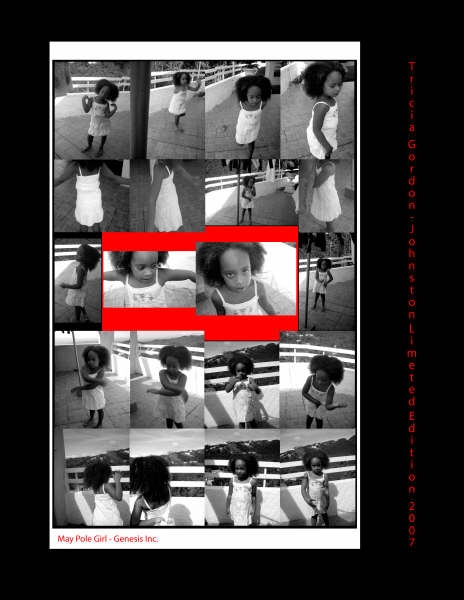
Tricia Gordon-Johnston: Balancing commercial and fine art practice


Tricia Gordon-Johnston is a practicing fine artist and recent graduate of Edna Manley College. She has exhibited in integral shows such as Curator's Eye II at The National Gallery in 2006 and SuperPlus Under 40 Artist of the Year 2006 at The Mutual Gallery. She currently does digital and photographic commercial design work alongside her artistic practice- not unlike many Jamaican artists. Her studio work however has been rooted in the conceptual tradition of feminist art and the tactile modernist work of various Latin American artists. ART:Jamaica has asked her to share some of her experience with balancing what has traditionally been thought to be conflicting forms of art.
Q. How do you balance art practice with your commercial work?
A. I think there is always a duality between Fine Art and Commercial work. Finding the balance, or the key must be in viewing both as art practice and contributing to our work each day, it is after all a way of life, as Petrona Morrison and Cecil Cooper used to state to us at The Edna Manley Collage of the Visual and Performing Arts.

Q.How did art college prepare you for real world survival?
A.College prepared me for the real world by both teaching me and reminding me that our vision of the world is what informs what we see from any perspective, if it is all beautiful, then it is all art, it's also what we make it.

Before I studied at Edna Manley Collage, I studied Business and Marketing. Now, as a practicing artist, I incorporate all three. The target market is also the audience, each possibly willing to purchase our version of our identity, as we project it on to a canvas.

I think our creative headspace is a Conceptual Space and not confined to a box, perhaps three boxes. I suppose the three boxes would be The National Gallery, the Mutual Gallery and of late I have also been thinking about The Cage Gallery. We each, I think bring something powerful, meaningful and excuisite to the table.

Also, when I sit at any table, I look and listen for live performance, that is what always transitions, for me, a circular table into a square of open-ended possibilities. I have also sat at many tables around the world and what makes me Nationalistic is both the way we fit in and stand out, internationally. Our Cultural 'flavour', if you will, is like an energy wire that connects us with consistent threads.

The fine arts are much like the fine art of everything. It may be an acquired taste, but if it ages like fine wine, then our identity is what reminds us that we have already done the healing an life is our Ackee and Saltfish, for the enjoy-ing.

Thursday, September 20, 2007

Mastering Ritual/ Ceremony/ Performance

This post has been long overdue. I apologize, but I felt I had to take time to think about some of the things that were happening in art locally. For the first time in a long time you could hear people talking about an art event. The event was the opening of the new space at Institute of Jamaica (IOJ) as marked by the show Mastering Slavery. The show occurs in parts with one segment at The National Gallery and another at The Museums Division at IOJ and their newly renovated temporary exhibition space at the bottom of East Street. The opening event began with a lecture at IOJ and then guests were led around to the new spaces to see the work of local artists who had made a work to loosely commemorate the abolition of the Slave Trade. The whole event has been heard in whispers and is mostly remembered for the performance of a work by Christoper Irons. Irons an artist generally known for his shock factor did a performance and installation which has been called everything from animal sacrifice to kumina ceremony to performance art.


Irons was dressed as what I felt was a kind of shaman or mystic man in the manner reminiscent of Kapo or Joseph Beuys. Irons set up the space using drawings on the wall of the rustic ex-furniture factory, chicken pan grills, chicken carcasses, welded iron and programmes from his grandmothers funeral among other bits. The morning of the exhibition something like 13 chickens Irons raises himself, were led into the space and presented with a bakery style cake. The cake was of some age as I remember it from his work in the JCDC Festival. The chickens seemed to sense something in their present future as they all herded together and sat nestled and still until the performance. I left after that but I have heard many interpretations and explanations of the performance. If you were there and wish to describe your experience please post a comment.

The piece follows on another performance with the sacrifice of chickens done in Trinidad. To see a video of this performance on YouTube please visit this link:http://youtube.com/watch?v=u-zO9w91myc

I have to ask these questions however, if performance art happens abroad, should it happen here. Is it hypocrisy or censorship to allow some kinds of performance and not others? Does the killing of animals go over in Jamaica as art? Is there difficulty in absorbing a work that speaks about ritual without being reverent?
On the other hand I want to mention Khepera Oluyia Hatsheptwa’s work now on show at Mutual Gallery, which interestingly reminded me a lot of Christopher Irons’ work. The work is an installation in the middle of the gallery called ‘AmenRa’ and though evoking the human presence and culture of ritual and ceremony from our heritage uses objects. What do you think of the two works compared side by side as addressing ritual and ceremony?


Over at the National Gallery shortly after was one of the best openings I have been to in a while. The performances from Amina Blackwood-Meeks, Jesse Ripole Dancers and the Rasta Nation were really engaging.


The show had a large enough crowd and showed diversity of work from Renee Cox’s re-interpreted Last Supper to Marvin Bartley’s digital imagery to Charles Campbell’s really poetic paintings and Christopher Clare’s images. It is a very pleasing show which is almost overwhelming in its offerings and hope that you take the opportunity to experience it.

Keith Morrison, curator of the upcoming Curator’s Eye III at the National Gallery, today announced his exhibition theme. Coincidentally or not so much, it is ‘Ceremony, Ritual, Celebration ’. He invites all interested arts practitioners to think about and submit proposals for work to him in January when he next visits the island. Collaboration and cross-disciplinary work is encouraged. The idea is that the show has performance, multimedia, sculpture, paintings etc. that is ongoing and occurring at different times in during the exhibition. It is a very exciting time for art and artists so remember no to miss out.

Tuesday, August 28, 2007

UPGRADED SUMMER EXHIBITIONS


Having seen two of the major juried shows this summer, the JCDC Fine Arts Festival and the Under 40, it is obvious that a handful of curators and arts administrators are really trying to reposition Jamaican art internationally by improving exhibition standards prevent the formation of a status quo and give it a swift jumpstart. The guest speaker at the opening of The SuperPlus Under 40 Artist of the Year Exhibition, Taynia Nethersole spoke of defending the reputation of Jamaican contemporary art. She mentioned the declaration of one collector in stating that art in Jamaica was stagnating. Imagine that. A breakaway from convention and focus on experimentation and cultural exploration as seen in the works of young artists such as Cleve Bowen, Kereina Changfatt, Paula Daley and Oya Tyehimba, being declared stagnant. Being a young artist myself that statement is a bit of a slap in the face signalling the loss of the faith in young artists that collectors of previous generations had. This is reconfirmed by one of Jamaica’s most prolific collectors, Wallace Campbell, in a recent interview stating that he rarely collected work from young artists however promising. Is this possibly why so few contemporary artists are barely able to earn a minimum from their work or curated contemporary art shows such as the Curator’s Eye receives a scanty amount of visitors or contemporary artists have to prove commercial viability before being able to book a show at top commercial galleries. Quite possibly, and it is a fact the art community has to live with and I suppose somehow we all get on with it. This resilience carries forth in the work that is out there in the galleries such as The Mutual Gallery and the The CAGE Gallery; the continued encouragement and growing quality of art coming from youth artists, self-taughts and art students by the Jamaica Development of Culture Commission.

I must say however that great encouragement comes from the publication of a very well designed and edited volume of The Jamaican entitled classically, ‘The Art Issue’. If my memory is right, it is the only publication to cover so wide a span of Jamaican art in a few years. It may be a bit pricy for the average student or struggling artist but is well worth it at a price of $850. It could just as well be entitled ‘The Intuitive Art Issue’ or ‘The National Gallery Companion’ as it does give the most space to a timeline similar to the curatorial schema of the National Gallery’s permanent collection and the idea of the Intuitive artist. The general avoidance of new directions in our contemporary art, concerns me a bit. I would have loved to have seen a bit more about artists working with printmaking, assemblage, video, photography. fibre arts, performance, drawing etc. Later in the volume however,features on Christopher Clare, who peeked our interest in The National Gallery’s, Curator’s Eye II and Laura Facey’s under-publicized Institute of Jamaica show were included.

Before closing, I am mentioning an item on my Christmas list for the Jamaican art scene: the renaming of the SuperPlus Under 40 Artist of the Year Exhibition/Competiton. Since it is modelled on the Turner Prize, which has since evolved into a brand partially because of its name which is now comparable to the Oscars and Tony’s, why not employ some of its publicity generating strategies. A brand-worthy name is priceless as evidenced by The Art Issue.

Note: For artists who are not yet aware the National Biennial’s Juried section has been merged with the JCDC Fine Arts Festival so next summer presents an opportunity to enter work once more when the JCDC sends a call to artists.
Also remember to see the Under 40 show at the Mutual Gallery and vote for your favourite body of work. Their artists talk is Tuesday August 28th, 2007 at 6pm.

Because I am sure I have stepped on toes feel free to voice your opinion by posting your comments.

Link to a related article in The Sunday Gleaner:
http://www.jamaica-gleaner.com/gleaner/20070826/arts/arts1.html

Monday, June 25, 2007

Confronting Persona’s and Bodies


A walk through the Edna Manley College’s 2007 final year show, particularly the fine arts department, and the body emerges as a general concern. Figures and bodies have always been a part of the imagery produced by exhibiting students but this year’s show seems significant in a sense that in its focus on how we image ourselves and others it seems the dissatisfied descendant of established Jamaican art. The number of confrontational bodies and personas seem also to indicate an underlying direction in contemporary Jamaican painting. These young artists seem to have absorbed and digested the various schools of thought on how to deal with the body and its identity.

Sheldon Clayton, shows the influence of Omari Ra and also Black-British artists such as Keith Piper. Being confronted by the double-headed, young and definitively black male seems both a confirmation of the expectation of threat as well as statement of existence. Nevine Salmon has also presented her own head as a confirmation of self with a work stating that ‘Self is the fact that I exist’. This presents a powerful statement coming from the Ceramics department, in which she attempts more than the expected mastery of media.

Nicole Harris also uses her own image but as a seemingly down-trodden, dollish life-size plaster-cast. She presented various versions of the figure going through transformations while remaining the same. Reading this work could lead us to think about the gender inequalities women face in our society, art etc. Beauty and feminine identity also seems a concern for her in the very precious way the casts are painted. This idea of feminine identity takes on sexual and grotesque tones in Gretel White’s work. Through her canvases she morphs and flickers between turtle and girl with the images paying particular attention to her legs. At some point we are presented with a turtles head hanging like a limp phallus between her bent legs. In front of her paintings I felt like a moth before a flame, looking felt politically incorrect but the imagery was too intriguing to look away.

Brenton Campbell in this sense, was not as much about presenting an intrigue as much as he was about presenting. In several paintings he presented comparisons and foreshortened views of shiny ‘plasticky’ or sketchy bodies. ‘Slim’ was expectedly contrasted with ‘Fat’ in a manner that reminded me of an architects 3D projection of flat drawings or Renaissance drawings plotting out perspective. His manner of working seem s directly derived from artworld superstars Lisa Yuskavage and Jennie Saville. His being male, I ask the question on the appropriateness of painting the objectified female body which would relate him more to the American artist John Currin. The sensual emergence of the female form is achieved in some of Monique Barnett’s paintings. The nude emerges from the paint in a way that gives the impression of the artist herself struggling to find a representation of her own image and an acceptance of its reflection.

The idea of the body as explored by canonized artist such as Ana Mendietta, Kiki Smith and Anthony Gormley is reflected in the space presented by Camille Chedda and Garth Daley. Daley draws silhouettes of bodies in rudimentary bread mixtures while Chedda draws larger than life faceless bodies, which are reminiscent of images of death and angels. She also presents us with a large female body, which seems to have appeared on her medium of choice, garbage bags, through torment. She has presented us with a female body, which is anything but sexual and thus points us in a direction to consider other issues surrounding the contemporary body. Again here as with Sheldon Blake, Garth Daley and Nevine Salmon, black and white is a deliberate palette choice. This seems to be a revisit/ resurrection/revival of the black as colour idealogy as a ploy to reclaim black as a conceptually loaded colour.

Ainsworth Case presents neat and tidy depictions of decapitated and objectified female and male bodies. Case seems to also be this years torch-carrier of the new figurative school of painting which has slowly been emerging from the Edna Manley College; going back to Khary Darby. Each year since Darby’s show I have watched the new members of the school explore personal and social issues through neoclassical depictions of cyborgs, iconic renderings of youth, the development of personal sign systems and loaded art historical reference.

Azariah Clarke interestingly exhibited in a room apart from the other fine artists as though he could anticipate his separation from the overarching concerns. His motif of masks became decidedly graphic and modernist in their genuine pursuit of formal concerns such as colour, shape and space. He presented a mixed media piece however that revealed the presence of a gas mask with black male faces pouring from the region of the mouth-piece. Gas mask generally not playing a large part in Jamaica’s history makes me think of the Holocaust and perhaps he is inciting an awareness of a black holocaust or similar oppression of the black male. Either way it is an interesting and chilling image for me in particular.

Joel Clayton’s shallow spaces seems to exist somewhere between Sheldon Clayton’s strong statements about self and identity, the sweetly pastel colours of Monet and the new breed of African-American painters such as Kehinde Wiley who devote themselves to representing the persona of the contemporary black or ‘urban’ male.

Before closing, I wish to note the similarity in themes and language indicates to me a common concern for the young artist or maybe the young Jamaican, There must be a particular concern and alertness to: a) the frustration of building a career as a contemporary artist in Jamaica, (b) the current terrors and tragedies of the globalised world (c) the struggle for Jamaican art to define itself in the contemporary at arena (d) the contemporary concern with the individual body and its shifting and redefined boundaries

The specific works highlighted in this article are in order to support points and are not intended as a statement of value or merit. The show will be presented as part of The Art on the Edge Festival at the Cage Gallery at Edna Manley College on Tuesday 26th at 6-8pm. Presented will be the work of other interesting graduating fine artists such as Marvin Bartley and Russell Gunning.

Monday, April 23, 2007

Time-based Media?

What is Time-based Media? Why is 'time' an issue of importance in digital media and the contemporary artist? Why is it relevant to the arts and artists in Jamaica? What qualifies a medium to be placed in this category and is it specific to medium or is it more of an approach or aesthetic? How does it function in the fine arts as opposed to the commercial industry?What applications has it been previously used for and what potential does it have for our cultural industry? What about the creative process differs from using non-time-based media and does it allow for intuition and inventiveness? Should its value as a product be different from that of other media?

Tuesday, April 17, 2007

New Media in Jamaican Art

What is new media, and how do you feel it can be used by Jamaican artists? What cultural interventions can occur through its use? Is it only for an elite set of privelaged techno-freaks? Does it deviate or dilute Fine Art or can it be used to assist the artistic process? Does it feel like a European or American import that is trendy at the moment or could there be more potential than we give it credit for? Should the artist using new media look to other mediums such as Painitng and Film to create value and determine aesthetics or does it require its own approach?

You are invited to discuss the above questions and raise your own.

Wednesday, April 11, 2007

WE ARE ABOUT FILM


A week or so ago, I was in attendance at the CPTC free Film Festival to see ‘The Future of Food’. The documentary was in keeping with the activist sentiment of many of the other films. It could be gathered that the audience was deeply affected by the intermittent muffled cries of surprise and shock at the thought of food being used as a political tool in America’s pursuit for world dominance. Conspiracy theories abound and left many of us vowing never to eat any food derived from U.S. corn produce (www.thefutureoffood.com). David Rubinson, the passionate festival organiser and CPTC for doing anything for free in our currently entrepreneur-driven Kingston and especially as it is something to benefit public awareness. Nevertheless what struck me about the festival was a statement made by Angela Patterson, CPTC’s CEO, before the screening: ‘We are about film’

CPTC is apparently seeking to secure its place in our still relatively untouched film industry. There is a lot of talk about film and Jamaica now particulary with the Brand Jamaica campaign which is active now. The idea of ‘Film’ and its related industry is cool, hip, seductive and perhaps for this reason connects with the image Jamaica presents to the world. What does it really mean to say we have a film industry? Which model will be employed in Jamaica: the Hollywood, Bollywood, Nollywood, European Avant-garde approach. Maybe it will be a new aesthetic related particularly to our culture. Will it have any bearing on artistic pursuit, fuelled and funded by political and state interests, or will it be replicas of imported genres? I suppose the point I am getting at is, what does it really mean to say in Jamaica that ‘We are about film’?